
Kwabahal (क्वाबहाल) – Maitripur Mahavihar (मैत्रीपुर महाविहार)
On this page
Introduction
Kwabahal (क्वाबहाल), formally known by its Sanskrit name Maitripur Mahavihar (मैत्रीपुर महाविहार), is a historic and sacred Newar Buddhist monastery in the heart of Kathmandu, just south of Thamel (ठमेल) and north of the neighborhood of Thahiti (ठहिटी) – See in Map . It is one of the oldest monastery of the Bajracharya community of the city, and it is the first name on the list of the eighteen main bahals of the Acharya Guthi (आचार्य गुथी). Tradition holds that it was founded in the fifth century CE by the tantric master Wak Bajra Bajracharya, whose sealed meditation room still stands beside the shrine.
Older scholarly books write the name as two words, Kwa Baha, but Kwabahal as a single word is what the neighborhood itself uses.
First among the 18 bahals
The 18 main bahals of Kathmandu are run by the Acharya Guthi, the body that oversees the initiated Bajracharya (बज्राचार्य) priests of the city. These eighteen are spread across four traditional quarters of the old city. The first is Thane Puin (थने पुइँ), which in today’s terms means Uptown. The others are Dathu Puin (दथु पुइँ), or Midtown; Layaku Puin (लायकू पुइँ), the quarter we now know as Durbar Square; and Kwane Puin (क्वने पुइँ), or Downtown.
Kwabahal belongs to Thane Puin, and it leads the list in two ways: it is named first, and it is treated as the oldest and most senior of the whole group. Thane Puin is linked above all with the famous tantric teacher Wak Bajra Bajracharya of Kwabahal.
It is worth pausing on what this four-part division tells us. Kathmandu had already organized itself into an uptown, a midtown, a palace quarter, and a downtown, each with its own monasteries and its own founding teacher, at a time when very few places in the world had city religious life arranged on that kind of scale.
The founder: Wak Bajra Bajracharya (वाक बज्र बज्राचार्य)
Kwabahal traces its founding to Wak Bajra Bajracharya , written in Sanskrit as वाक बज्र बज्राचार्य. Older books spell his name in several ways, including Vakvajra, Vak Vajra, and Wak Vajra Vajracharya. Tradition places him in the fifth century CE, during the Licchavi (लिच्छवि) period, and credits him with setting up Maitripur Mahavihar as a center for learning and practicing Vajrayana (वज्रयान) Buddhism. He is remembered as one of the four great Bajracharya mahasiddhas (महासिद्ध) of Kathmandu, a master of tantric practice, and the author of several Buddhist texts. His name comes from the Sanskrit word for speech or sound, which tradition reads as a sign of the role he would go on to play as a teacher.
The best known story about him is about the Si Gha Chaitya (सिघः चैत्य), the stupa near Thahiti that is also called Shree Gha (श्रीघः) and known locally as Kathe Swayambhu (काथे स्वयम्भू). He is said to have brought it from Kashi (काशी), today’s Vanarasi (वाराणसी), through the power of his meditation. After finishing that work he returned to Kwabahal and sat down to meditate in the small room beside the shrine. One version of the story says he is still there in meditation today. Another says he vanished from that room. Either way, the room still exists. It is kept locked at all times, honored as his shrine, and nobody goes inside.
Oral tradition says Wak Bajra had two sons, Manjupala (मञ्जुपाल) and Majindrapala (मजिन्द्रपाल). The families of Musya Bahal say they descend from Majindrapala, while the rest of the Kwabahal community traces itself back to Manjupala. Kwabahal also has close ties to two other places connected with him: a shrine at Si Gha (सिघः) and Thambahi (ठंबही). The name Thambahi comes from Tham, the old word for the uptown area, so it is simply the bahi of uptown.
Note: Readers should know that this account comes from family memory, Sanskrit legend, and local tradition rather than from dated stone inscriptions. The written record of the monastery, covered further down, starts many centuries later. Both kinds of evidence matter, and it is best to keep them clearly apart.
Paramadi Bajra Bajracharya (परमादी बज्र बज्राचार्य)
Kwabahal is remembered for a second mahasiddha as well. Paramadi Bajra Bajracharya, written in Sanskrit as परमादी बज्र बज्राचार्य, was a Bajracharya of Kwabahal who is believed to have reached enlightenment, or nirvana.
Tradition credits him with building the Purano Guheswari temple near Balaju, Kathmandu – See in Map . The temple is dedicated to Nairatmya (नैरात्मा), known here as Guheswari (गुहेस्वरी), together with Hevajra (हेवज्र). The name Purano Guheswari means the old Guheswari, and it marks this temple as the old and original Guheswari of Kathmandu, set apart from those built later.
He is believed to have reached enlightenment at Dhike Pako (धिके पाको), a cave at the foot of Nagarjuna hill, which the newer community also calls Jamacho (जामाचो). The link has not faded. Every year the Bajracharya gurus of Kwabahal go to the Dhike Pako cave to worship there and pay homage to their ancestor Paramadi Bajra Bajracharya.
The courtyard and the shrine
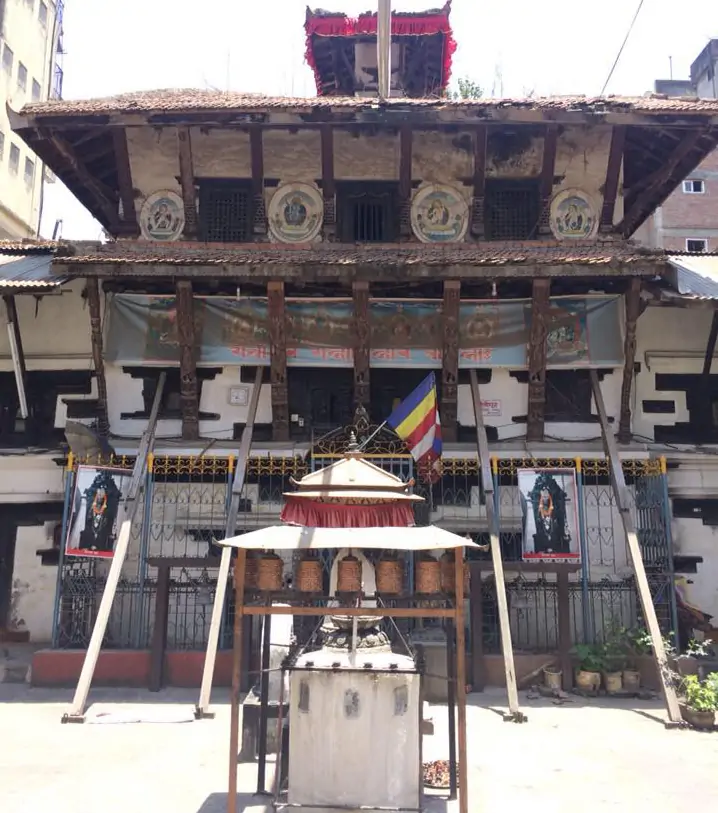
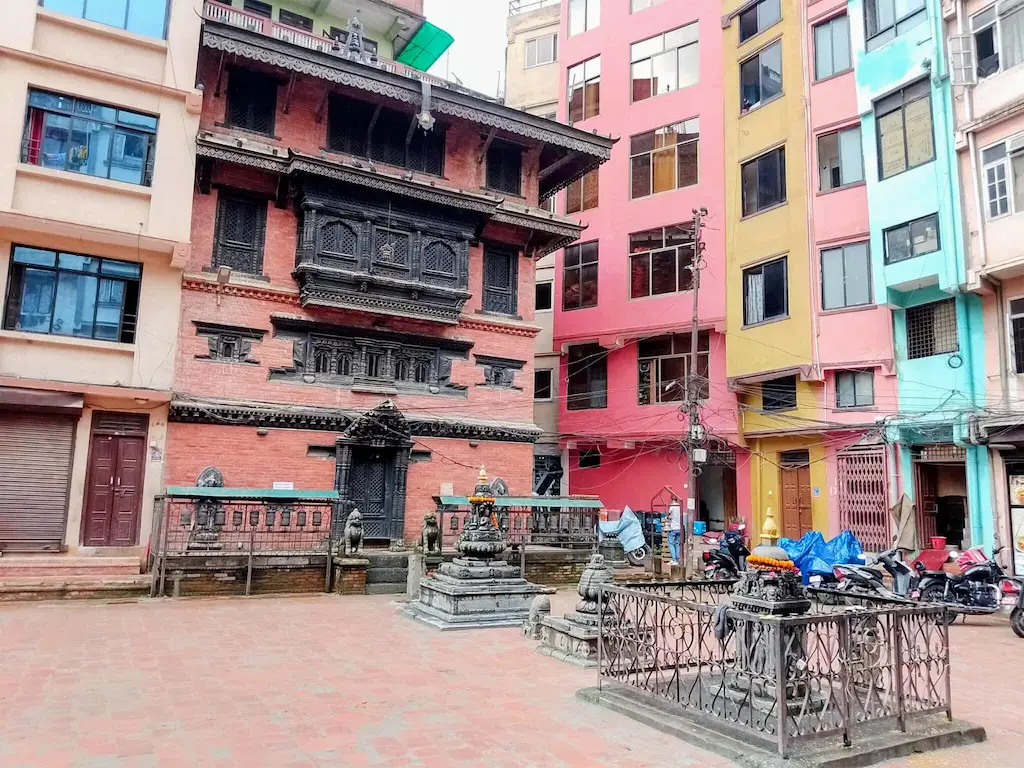
The monastery sits around a courtyard that still follows much of the traditional bahal layout. Parts of the buildings around it have been rebuilt over the years, so a visitor today sees a mix of old and newer work rather than one matching set of buildings. Even so, the shape of the courtyard and the shrine at its center are easy to make out.
The shrine is three stories tall with a small dome on top, which is a feature you more often see on a bahi than on a bahal. The first floor has the usual wide window with five openings, with a smaller window on each side, and a tiled roof above it. The top floor has three plain windows with wooden lattice screens, and the tiled roof above them is crowned by the dome.
The doorway is the best part of the building. Its carved frame has an image of Sariputra (शारिपुत्र) on one side and Maudgalyayana (मौद्गल्यायन) on the other, the two main disciples of the Buddha. Above the door is the main torana (तोरण), the carved panel that sits over the doorway, above the shrine of the kwapa-dya (क्वापाःद्यः), the monastery’s main image. This torana is made of hammered metal and carries no date. A second torana at the entrance to the courtyard is made of wood, is older, and shows exactly the same figures. It is dated Nepal Samvat 789, which is about AD 1669.
Both toranas show the same group of figures. In the middle is the Buddha as Dharmadhatu Vagishvara (धर्मधातु वागीश्वर). On his right is the Dharma in the form of Prajnaparamita (प्रज्ञापारमिता), and on his left is the Sangha in the form of Shadakshari Lokeshvara (षडक्षरी लोकेश्वर). Around them are four of the five tantric Buddhas; Vairocana (वैरोचन) is not shown.
The upper floors still carry traces of the wall paintings that once showed a range of Buddhist deities. The ground floor front was replastered with cement not long ago, so any painting there is gone.
Kwapa-dya: The main image
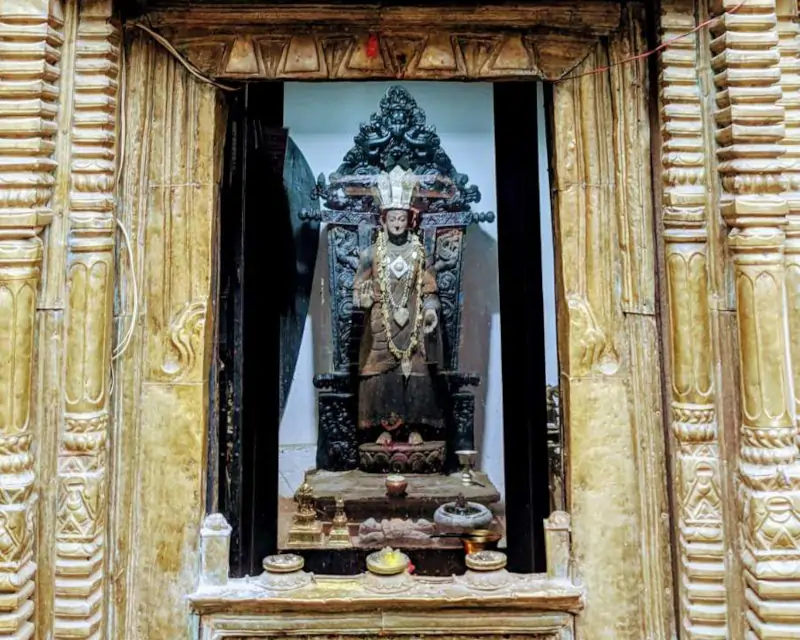
The kwapa-dya , the main image of the monastery, is a standing figure of the Buddha. The left hand is raised in the abhaya mudra (अभय मुद्रा), the gesture that means do not be afraid, and the right hand makes the gesture of teaching.
People do not agree on who the figure is. The survey published as Kathmandu Valley: The Preservation of Physical Environment and Cultural Heritage calls it Dipankara (दीपंकर). Local people say it is Maitreya (मैत्रेय), which matches the monastery’s Sanskrit name, Maitripur. Judging only by how the figure is shown, it follows the usual way of showing Dipankara.
Inside the shrine there are about twenty images. Among them is a small wooden figure that matches the main image, and a small chaitya. Two metal lions stand beside the steps up to the shrine, and there is a bell on the left. The courtyard also holds an “Ashoka Chaitya”, a small chaitya set on a pillar, and several other images.
The community and its daily worship
The sangha, meaning the community of initiated men who hold rights in the monastery, is made up of thirty-four families with 293 initiated Bajracharyas. That count includes the members of Musya Bahal, the one branch of Kwabahal.
Few of these families still live inside the bahal, and daily worship has become simpler as a result. It now consists of the morning puja (पूजा) and the lighting of the lamp in the evening. The dya-pala, the priest on duty, used to stay in the shrine for his whole turn of service, but that practice has stopped, and he usually comes only in the morning and the evening for the set rituals. Every member of the sangha takes a turn of one month, going in order through the list of initiated members. The sangha has five elders.
The yearly festival falls on the eighth day of the bright half of Phalgun (फाल्गुन). Kwabahal is also where initiations take place. Both the Bare Chuyegu (बरे छुयेगु) and the Acha Luyegu (आचा लुयेगु) ceremonies are held here for the sons of members, including the sons of the branch monastery. The lineage deity of the sangha (संघ) is Yogambara (योगाम्बर), worshipped at Mhepi Ajima (म्हयपी अजिमा) .
The Kumari of Kwabahal
Kwabahal had its own Kumari (कुमारी), a living goddess chosen from among the daughters of sangha members. The practice was stopped around 1990, and no Kumari has been installed at Kwabahal since. What follows describes the tradition as it was when it was still kept.
This Kumari was Buddhist in a strict sense. She was worshipped only as Vajradevi (वज्रदेवी) and never as Durga (दुर्गा), which made her different from the better known Royal Kumari of Kathmandu. Although she belonged to Kwabahal, most of her duties took place at Thambahi, where Bajracharyas serve as priests.
Installing a new Kumari followed a set order. The ceremony brought the old and the new girl together. The old Kumari sat on her throne wearing all her jewelry, and the new girl sat on a mat in front of her. A Bajracharya priest of Kwabahal passed the divine power from the old girl to the new one and placed a garland of flowers around the neck of the girl who was stepping down. She then took off her jewelry and got up from the throne, and the father of the new Kumari seated his daughter on it. The girl who was leaving the role was dressed in ordinary everyday clothes, while the new one was given a new set of red clothes paid for out of the guthi funds. The old Kumari’s formal hairstyle was undone and the new girl’s hair was done up. Finally, after the old Kumari and her parents had been given a feast, the new goddess was dressed in all her jewelry and worshipped by the priest.
The written record and where the name came from
Next to the traditional history there is the written record. In the published surveys of the valley, the earliest dated mention of the monastery comes from an inscription at Si Gha dated N.S. 672, about AD 1552, which names a monk of Kvatha Vihara (क्वथ विहार) who belonged to a guthi (गुथी) there. This older form of the name shows up in several inscriptions.
The name itself carries the older history. Kvatha (क्वथ) is a Sanskrit word that means hot or boiling, and Kvatha Vihara (क्वथ विहार) was the monastery’s original name. Over time, Newar speakers shortened the Sanskrit kvatha to kwa (क्वा), and vihara (विहार) gave way to the everyday Newar word bahal (बहाल). Kwa plus bahal gives Kwabahal, the name used in the neighborhood today. So the short local name still holds inside it a Sanskrit word that was in use long before the Newar one.
The Sanskrit literary name appears later. A copy of the Aparimitayur Dharani Sutra (अपरिमितायुर्धारणी सूत्र) made in N.S. 779, about AD 1659, names the scribe as Jinadeva, a Bajracharya of Maitripuri Mahavihar. Later mentions usually give the name as Maitripur.
The gurujus (गुरुजु) of Kwabahal, the senior priests of the monastery, say that records kept at Kwabahal go back as far as the fifth century CE, which would place the monastery’s own written memory alongside the traditional date of its founding. Documents of that age held within a monastery are not the same thing as a dated public inscription, and the surveys cited at the end of this article worked only from inscriptions and manuscripts that had been published. The monastery’s own holdings are the natural place to look next, and the gurujus remain the first authority on what those holdings contain.
The gap between the fifth-century founding held in tradition and the sixteenth-century inscription is normal for monasteries in this valley. Wooden buildings burn down, fall down, and get rebuilt, and inscriptions and manuscripts survive largely by luck. The lack of an early dated record in the published surveys says more about what those surveys covered, and about how fragile the evidence is, than about any break in the monastery itself, whose priestly line, membership, and yearly round of rituals have carried on without interruption in living and remembered practice.
Musya Bahal (मुस्या बहाल), Karunapura Vihar (करुणापुर विहार), Jyatha: The branch
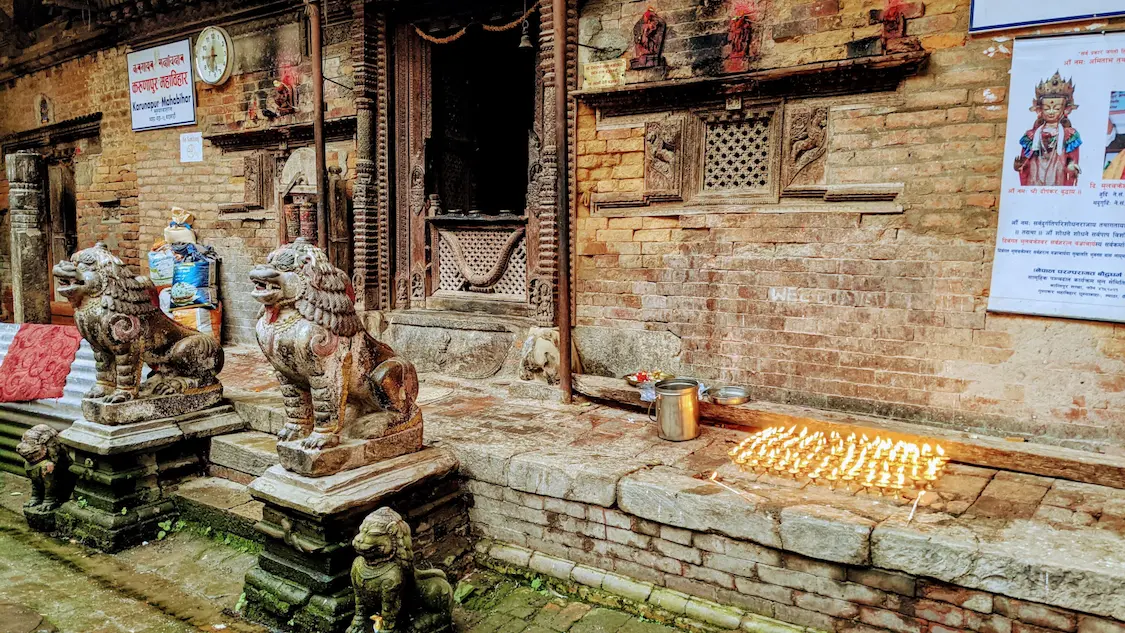
Musya Bahal is extension or branch of Kwabahal. It is one of the few bahals in Kathmandu that still stands complete in Jyatha, Kathmandu – See in Map .
The whole building is two stories, including the shrine, which has two stone lions at its entrance. A wooden torana over the shrine doorway shows the Buddha as Dharmadhatu Vagishvara, with the Dharma as Prajnaparamita on his left and the Sangha as Shadakshari Lokeshvara on his right. Above them are four of the five tantric Buddhas. The main image here is Akshobhya (अक्षोभ्य), facing north.
A band running around the upper part of the ground floor still holds traces of old wall paintings. The tiled roof of the whole building rests on carved wooden supports that show various tantric Buddhist deities, and a single ornament sits at the top of the shrine roof. The courtyard is paved in brick with one chaitya in the middle. Just inside the entrance from the street are shrines to Ganesh (गणेश) and Mahakal (महाकाल), and above the street entrance is a torana showing Namasangiti (नामसंगीति), dated N.S. 713, about AD 1593.
The community here are Bajracharyas of Kwabahal, all of whom say they descend from Majindrapala. Members take turns with the morning and evening rituals, working down the list from oldest to youngest. No initiations (Bare Chuyegu) happen at Musya Bahal; they are held only at Kwabahal. The yearly festival falls on the fifth day of the bright half of Magh (माघ), and the branch community has one elder.
The date of the building is unclear. The main torana is dated N.S. 805, about AD 1685, while the torana over the street doorway is dated N.S. 713, about AD 1593. The heritage survey named at the end of this article gives the building date as AD 1663, or N.S. 783, but does not say where that date comes from, and the older torana seems to contradict it. Oral tradition says Musya Bahal was founded by Majindrapala, the son of Wak Bajra Bajracharya.
References, sources and spelling
The description of the buildings, the community, and the round of rituals draws on Buddhist Monasteries of Nepal by John K. Locke (1985), on Prasiddha Bajracharya by Badri Ratna Bajracharya (1988), and on the heritage survey published as Kathmandu Valley: The Preservation of Physical Environment and Cultural Heritage.
Newar and Sanskrit words are written here in plain English letters without accent marks, with the Devanagari script given at first mention. The history in this article was made in a Sanskrit and Newar writing culture, and the original script carries meaning that plain English letters lose. Personal names and community words use the b spelling that local people use, as in Bajracharya and Wak Bajra, while Sanskrit religious terms and deity names keep the v spelling, as in Vajrayana and Vajradevi.
Nepal Samvat (नेपाल संवत्) dates are turned into Common Era dates by adding about 880 years. The equivalents given above are approximate, because the Nepal Samvat year does not line up with the Western calendar year.
A short word list may help. A bahal (बहाल) is a Newar Buddhist monastery built around a courtyard, from the Sanskrit word vihara (विहार). A bahi (बही) is a related but differently built type of monastery. Kwapa-dya (क्वापाःद्यः) is the main image of a bahal. A torana (तोरण) is the carved panel above a doorway. A chaitya (चैत्य) is a small stupa, a rounded shrine built as an offering. Dya-pala (द्यःपाला) is the priest on duty. A guthi (गुथी) is a trust that looks after a religious institution and its property. A sangha (संघ) is the community of initiated members who hold rights in a monastery.
Frequently asked questions
- What is Kwabahal?
Kwabahal (क्वाबहाल) is a Newar Buddhist monastery in central Kathmandu, just south of Thamel and north of Thahiti. Its formal Sanskrit name is Maitripur Mahavihar (मैत्रीपुर महाविहार). It is the oldest and highest ranking monastery of the city’s Bajracharya community.
- Who founded Kwabahal?
Tradition credits the tantric master Wak Bajra Bajracharya (वाक बज्र बज्राचार्य), who is placed in the fifth century CE during the Licchavi period. He is remembered as one of the four great Bajracharya mahasiddhas of Kathmandu.
- Where does the name Kwabahal come from?
From the Sanskrit Kvatha Vihara (क्वथ विहार). Kvatha means hot or boiling. Over time Newar speakers shortened kvatha to kwa and replaced vihara with the everyday word bahal, giving Kwabahal.
- Why is Kwabahal called the first bahal?
It is the first name on the list of the eighteen main bahals run by the Acharya Guthi, and it is treated as the senior foundation of that whole group.
- What are the four quarters of old Kathmandu?
Thane Puin (थने पुइँ) or Uptown, Dathu Puin (दथु पुइँ) or Midtown, Layaku Puin (लायकू पुइँ) or Durbar Square, and Kwane Puin (क्वने पुइँ) or Downtown. Kwabahal belongs to Thane Puin.
- Who was Paramadi Bajra Bajracharya?
Paramadi Bajra Bajracharya (परमादी बज्र बज्राचार्य) was a mahasiddha of Kwabahal who is believed to have reached enlightenment at Dhike Pako, a cave at the foot of Nagarjuna hill. Tradition credits him with building the Purano Guheswari temple of Hevajra and Nairatmya near Balaju. Every year the Bajracharya gurus of Kwabahal go to the cave to pay homage to him.
- What is the locked room beside the shrine?
It is the meditation room of Wak Bajra Bajracharya. One version of the story says he is still meditating inside; another says he vanished from it. The room is kept locked at all times and nobody enters.
- Who is the main image in the shrine?
The kwapa-dya is a standing Buddha with the right hand in the teaching gesture and the left raised in the abhaya mudra. A published heritage survey calls it Dipankara, while local people say it is Maitreya, which matches the name Maitripur.
- Did Kwabahal have its own Kumari?
Yes. She was chosen from the daughters of sangha members and was worshipped only as Vajradevi, never as Durga. The practice was stopped in 1991 and no Kumari has been installed since.
- What is Musya Bahal?
Musya Bahal (मुस्या बहाल), or Karunapura Vihar (करुणापुर विहार), at Jyatha is the one branch of Kwabahal. Its eighty-four Bajracharya members trace their descent from Majindrapala, a son of Wak Bajra Bajracharya. Initiations for its members are held at Kwabahal, not there.
- How old is the written record of Kwabahal?
The gurujus of Kwabahal say that records kept at the monastery go back to the fifth century CE. In the published surveys, the earliest dated mention is an inscription at Si Gha from N.S. 672, about AD 1552, naming a monk of Kvatha Vihara. Those surveys worked only from published inscriptions and manuscripts, so they do not cover what the monastery itself holds.
Continue reading
Bahals and Mahavihars
Gam Bahal (गम बहाल) – Hemavarna Mahavihar (हेमवर्ण महाविहार)
Bahals and Mahavihars
Dhwaka Bahal (ध्वाका बहाल) – Henakar Mahavihar (हेनाकर महाविहार)
Bahals and Mahavihars