
Dhwaka Bahal (ध्वाका बहाल) – Henakar Mahavihar (हेनाकर महाविहार)
On this page
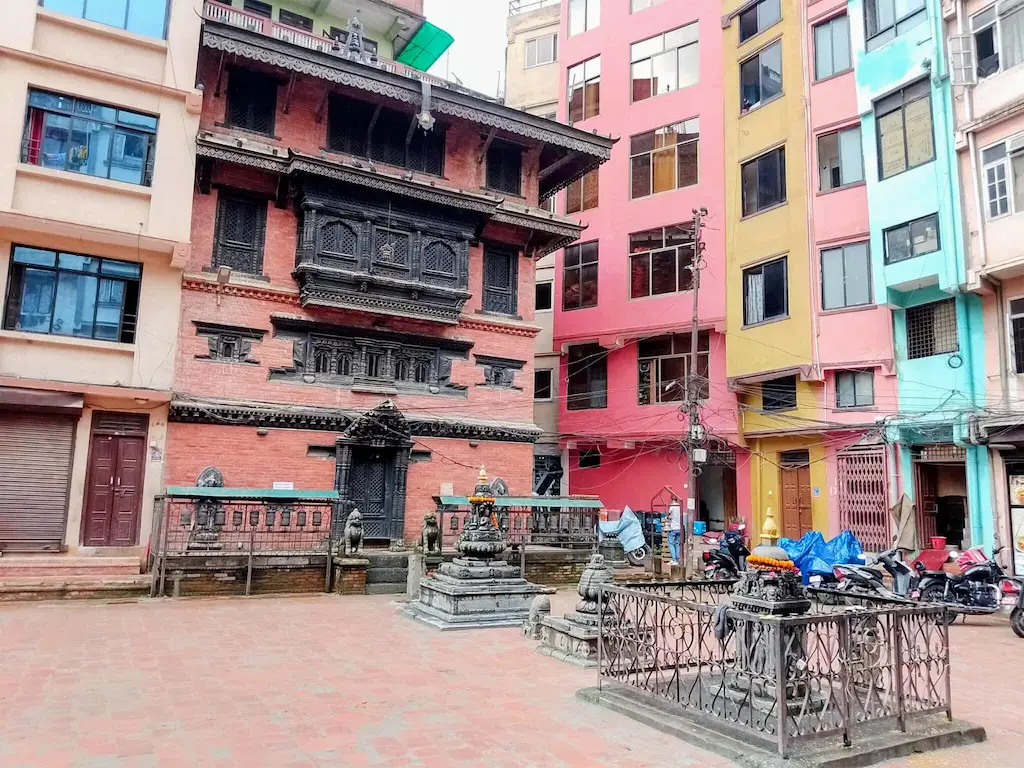
Dhwaka Bahal (ध्वाका बहाल), formally known by its Sanskrit name Henakar Mahavihar (हेनाकर महाविहार) and called Dhoka Bahal by many local people, is a Newar Buddhist monastery at Tyauda in central Kathmandu – See in Map . It is one of the eighteen Acharya Guthi bahals of the Kathmandu Valley, the main monasteries overseen by the Acharya Guthi (आचार्य गुथी), the body that governs the initiated Bajracharya (बज्राचार्य) priests of the city, and it belongs to Thane Puin, the uptown quarter of the old city.
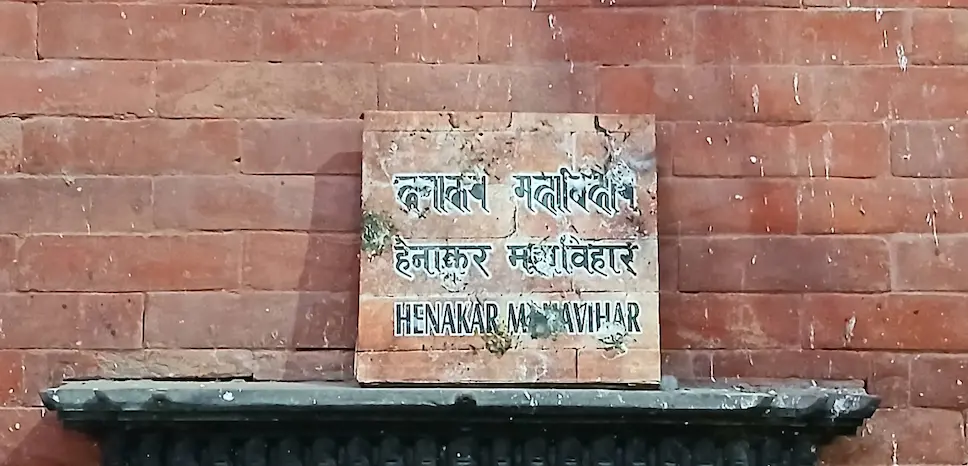
Two pieces of stone in its courtyard carry the site back to the seventh century, which makes Dhwaka Bahal one of the few monasteries in Kathmandu where the age of the ground can be seen rather than only told.
The community of the monastery keeps a Facebook page for it: Henakar Mahavihar on Facebook .
The courtyard and the shrine
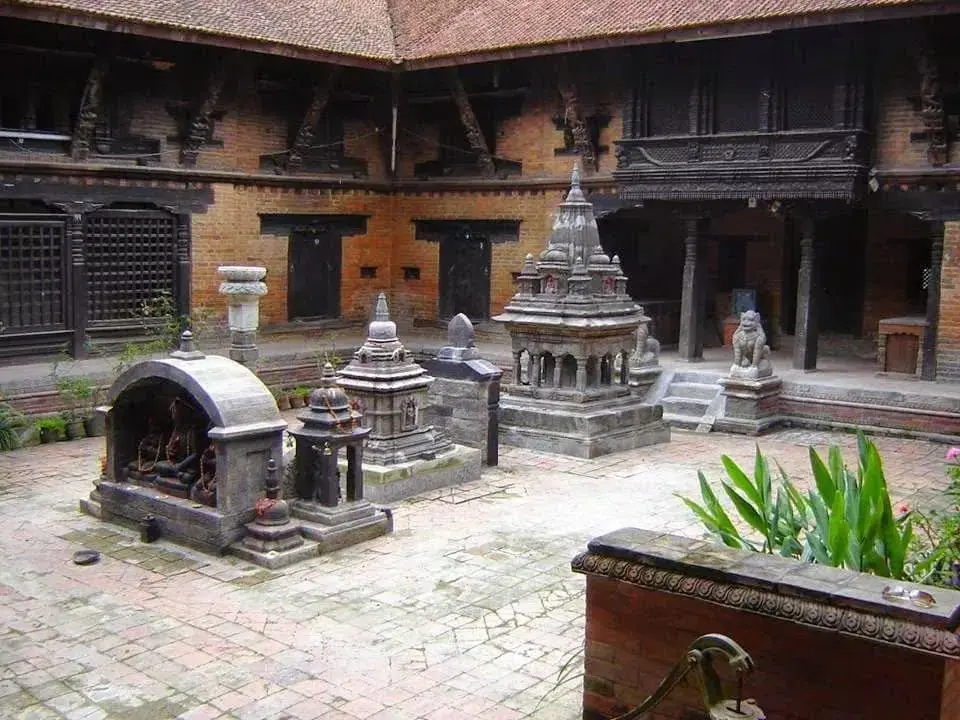
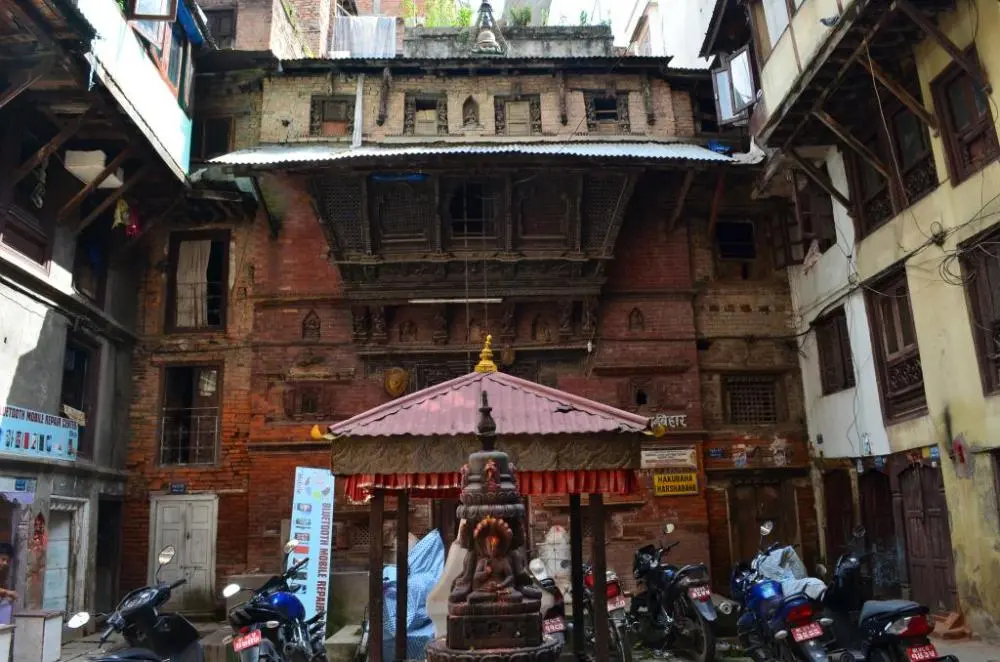
Dhwaka Bahal has a spacious courtyard, with the shrine of the Kwapa Dya (क्वापाःद्यः), the presiding deity of the monastery, in the southeast corner.
Nothing is left of the original bahal architecture. The shrine standing today is a newer building, a plain brick structure of three floors that looks more like an ordinary house than a monastery.
The entrance at ground level is marked by two stone lions. The carved doorway is topped by a torana (तोरण), the carved panel that sits above a doorway, showing Dharmadhatu Vagishvara (धर्मधातु वागीश्वर) surrounded by six other tantric deities. On either side of the doorway stand large stone relief figures of Sariputra (शारिपुत्र) and Maudgalyayana (मौद्गल्यायन), the two chief disciples of the Buddha.
The first floor has the usual wide window with five openings, with a smaller window on each side. Above the central window is a second wooden torana. This one shows a four-armed Prajnaparamita (प्रज्ञापारमिता) at the center, surrounded by the five transcendent Buddhas, with a figure of Vajrasattva (वज्रसत्व) above.
The Kwapa Dya
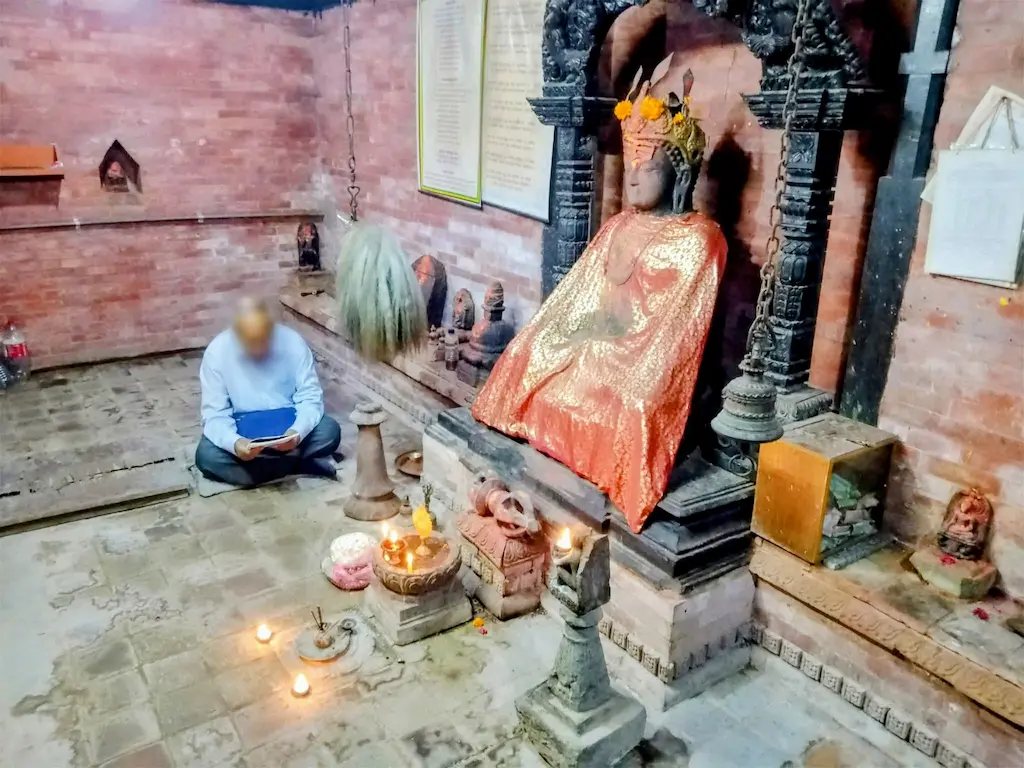
The Kwapa Dya is the main deity of a bahal, kept in the shrine across the courtyard from the entrance, and its name means guardian of the community.
The Kwapa Dya of Dhwaka Bahal is an image of Akshobhya (अक्षोभ्य), facing north. About ten other images of various kinds stand inside the shrine with it.
The chaityas in the courtyard
Three chaityas (चैत्य) stand in the courtyard, directly in front of the shrine. Two of them are far older than anything else at Dhwaka Bahal, and both date from the seventh century AD.
The older-looking of the two is a sarvatobhadra chaitya, which means it has a figure facing each of the four directions. The four standing figures are Sakyamuni Buddha; a second Sakyamuni with his hand in the vishvavyakarana mudra (विश्वव्याकरण मुद्रा), a gesture people here usually read as Maitreya; Vajrapani (वज्रपाणि); and Avalokiteshvara (अवलोकितेश्वर). Above them runs a second row, with a seated Buddha above each standing figure. All four of the seated figures show the Buddha in meditation. Scholars have consistently dated this piece to the seventh century.
The other is a small chaitya with writing carved on it. The words are the short Buddhist verse that begins Ye Dharma, and the letters are in the style used in the time of the Licchavi (लिच्छवि) king Narendradeva, in the middle of the seventh century.
These two stones matter because they push the site back much further than anything else here. The buildings around them are modern and the written record of the monastery starts far later, but people were worshipping on this ground in Licchavi times.
Where the community came from
It used to be said that the Bajracharya community of Dhwaka Bahal did not begin in Kathmandu at all. The story was that they came from Sankhu (सांखु) and moved to the city a very long time ago. This was written down in the 1980s by John K. Locke, who heard it from Bajracharyas of the bahal at that time. It is not a story that is widely told today.
No document records any such move. What the story did have behind it was the lineage deity, the deity a family belongs to. For this community that deity is a chaitya at Sankhu, which is a long way from Kathmandu and not an obvious place for it to be.
No date was ever given for when the move happened, and it was never clear whether the community built a new monastery once it reached Kathmandu or took over one that was already standing empty.
Initiations
Both Bare Chuyegu (बरे छुयेगु) and Acha Luyegu (आचा लुयेगु) are performed at Dhwaka Bahal for the sons of the members. These are the two ceremonies that make a boy a monk and then a man a full Bajracharya priest.
Chhusya Bahal (छुस्या बहाल) - Gunakar Vihar, Jyatha
Chhusya Bahal (छुस्या बहाल), or Gunakar Vihar (गुणाकर विहार), at Jyatha is one of the two branch monasteries of Dhwaka Bahal – See in Map . It is probably the finest example of bahal architecture left standing in the Kathmandu Valley. Unlike most monasteries, which sit back behind a lane, it stands right on the street, and the visitor walks in through a street doorway flanked by two stone lions and topped by a fine torana showing Prajnaparamita.
Inside is a quadrangle around a sunken brick courtyard. The ground floor has three open halls facing that courtyard. The first is at the entrance, with a shrine of Mahakal (महाकाल) on the right and one of Ganesh (गणेश) on the left. The other two halls run along the eastern and western wings.
Directly opposite the entrance is the shrine of the Kwapa Dya, which like the rest of the buildings is only two floors high. Two stone elephants mark its entrance, and the carved doorway is topped by a torana with Maha-Akshobhya at the center, surrounded by ten other tantric deities. The Kwapa Dya is an image of Akshobhya, facing north. The first floor has the usual wide window with five openings and a smaller window on each side, and a single finial sits on the roof directly above the shrine.
The building is unusual inside as well. Each corner of the ground floor holds two smaller rooms, and from each corner a stairway leads up to the first floor, where three rooms open off each stairway with no doors between them. The result is four completely separate apartments within one building. The roof is tiled and the space beneath it is unused.
The most striking feature is the series of beautifully carved roof struts, each one carved with the name of the deity it portrays. In the courtyard stand two chaityas, an image of Tara (तारा), and a stone image of Vajrasattva flanked by the two people who donated it.
An inscription at the bahal dated N.S. 788, about AD 1668, records that construction was completed in N.S. 769, about AD 1649, and that an image of Harihara Lokeshvara (हरिहर लोकेश्वर) was installed in the shrine at that time. The donors were the Bajracharya Gunajyoti of Dhwaka Bahal, together with his first wife Yadumani Lakshmi and his second wife Helmani Lakshmi. In N.S. 788 Gunajyoti invited Pratap Malla, the king of Kathmandu, to the ceremony marking the official opening.
The dates on the building do not all agree with that account. The torana over the outer doorway is dated N.S. 793, about AD 1673, and the one over the shrine entrance N.S. 796, about AD 1676. The carved roof struts, meanwhile, were dated to the fourteenth century AD by S. B. Deo, and later writers have agreed with him. The Kwapa Dya in the shrine is Akshobhya, not Harihara Lokeshvara.
Taken together, the evidence suggests the bahal was renovated rather than built in N.S. 769, with the struts surviving from a much older structure, and that the donation of the Harihara Lokeshvara image came some years afterward. It was the consecration of that image to which Pratap Malla was invited.
Haku Bahal (हाकु बहाल) - Harsha Chaitya Vihar, Asan
Haku Bahal (हाकु बहाल), or Harsha Chaitya Vihar (हर्ष चैत्य विहार), at Asan is the other branch monastery of Dhwaka Bahal – See in Map . It is a very small and entirely enclosed courtyard just off Asan. Its shrine has the characteristic three floors of a bahal shrine, with a fourth added more recently. The entrance sits just above ground level and is marked by two stone lions.
The carved doorway is topped by a torana showing the five Buddhas in their tantric form, with Dharmadhatu Vagishvara at the center, four other tantric Buddhas around him, and Vajrasattva above.
The Kwapa Dya is a standing image of the Buddha showing the vishvavyakarana mudra, usually identified here as Maitreya (मैत्रेय). It faces north.
The front of the building is worth looking at closely. The first floor has a triple window flanked by two smaller ornate windows. The second floor has a finely carved projecting bay window. The top floor is used as living quarters but carries a number of carved roof struts that must have been taken from an earlier building. On the roof is a single gajura (गजुर), the crowning ornament, made in the form of a chaitya.
In the courtyard stands an Ashoka Chaitya along with several images, among them Maitreya, Manjushri (मञ्जुश्री) and Padmapani (पद्मपाणि).
Nothing is written down about how Haku Bahal was founded. The story people tell is that the Sanskrit name comes from a man named Harsha, who built the monastery and gave it to the original sangha. The earliest date anywhere in the complex is the one on its torana, N.S. 771, about AD 1651.
The written record
The earliest dated document that mentions the monastery is a palm-leaf land grant of Nepal Samvat (नेपाल संवत्) 701, about AD 1581, where the name appears as Dhvakha Bahara. After that date, references become common. Bajracharyas of Dhwaka Bahal are named again and again in inscriptions across Kathmandu as the priests officiating at rituals elsewhere in the city, which shows how far the monastery's priests worked beyond their own walls.
The Sanskrit name Henakar Mahavihar first appears in a document of N.S. 777, about AD 1657. Two documents record an elaborate Samyak ceremony held in that year by a family of this monastery. Samyak is the great alms-giving festival of Newar Buddhism, at which the Bare, the initiated members of the community, are formally fed. The Bajracharya Sri Jnanajoti, his son Gunajoti, his grandson Dhanasimha, his great-grandson Parikhadeva and others hosted the ceremony on the day of Makara Sankranti. The king, Pratap Malla, attended, along with a reported 7,500 Bare and gods.
In N.S. 812, about AD 1692, the same Parikhadeva repaired the chaitya and the golden finial of the shrine and set up an image of Akshobhya.
A note on sources and spelling
The description of the buildings, the courtyard and the inscriptions draws on Buddhist Monasteries of Nepal by John K. Locke (1985).
Newar and Sanskrit words are written here in plain English letters without accent marks, with the Devanagari script given at first mention. The history in this article was made in a Sanskrit and Newar writing culture, and the original script carries meaning that plain English letters lose. Personal names and community words use the b spelling that local people use, as in Bajracharya, while Sanskrit religious terms and deity names keep the v spelling, as in Vajrapani.
Nepal Samvat dates are turned into Common Era dates by adding about 880 years. The equivalents given above are approximate, because the Nepal Samvat year does not line up with the Western calendar year.
This article is part of a series on the bahals of the Kathmandu Valley, and it is meant to be corrected and added to over time. If anything here is wrong, incomplete or out of date, please get in touch so it can be put right. Corrections from the sangha of the bahal itself, and from families who know these places from the inside, are especially welcome.
A short word list may help. A bahal (बहाल) is a Newar Buddhist monastery built around a courtyard, from the Sanskrit word vihara (विहार). Kwapa Dya (क्वापाःद्यः) is the presiding deity of a bahal, the main image in its shrine. A torana (तोरण) is the carved panel above a doorway. A chaitya (चैत्य) is a small stupa, a rounded shrine built as an offering. A sarvatobhadra chaitya is one with a figure facing each of the four directions. A gajura (गजुर) is the ornament crowning a roof. Samyak (सम्यक्) is the great alms-giving festival at which the Bare are fed. A guthi (गुथी) is a trust that looks after a religious institution and its property.
Frequently asked questions
- What is Dhwaka Bahal?
Dhwaka Bahal is a Newar Buddhist monastery at Tyauda in central Kathmandu, one of the eighteen Acharya Guthi bahals of the Kathmandu Valley. Its Sanskrit name is Henakar Mahavihar.
- Where is Dhwaka Bahal located?
At Tyauda, also spelled Tyouda, in central Kathmandu. It belongs to Thane Puin, the uptown quarter of the old city.
- Is Dhwaka Bahal the same as Dhoka Bahal?
Yes. Dhoka Bahal is the name many local people use for the same monastery.
- How old is the site?
Two of the three chaityas in the courtyard date from the seventh century AD. One is a sarvatobhadra chaitya with a figure facing each direction; the other carries writing in the letter style used in the time of the Licchavi king Narendradeva. Both show that people were worshipping on this ground in Licchavi times.
- What is the Kwapa Dya of Dhwaka Bahal?
An image of Akshobhya, facing north. About ten other images stand in the shrine with it.
- Where did the community of Dhwaka Bahal come from?
It used to be said that they came from Sankhu and moved to Kathmandu long ago. The story was recorded in the 1980s and is not widely told today. What lay behind it is that the community's lineage deity is a chaitya at Sankhu.
- What initiations are held at Dhwaka Bahal?
Both Bare Chuyegu and Acha Luyegu, the ceremonies that make a boy a monk and then a man a full Bajracharya priest.
- What are the branches of Dhwaka Bahal?
Chhusya Bahal (Gunakar Vihar) at Jyatha and Haku Bahal (Harsha Chaitya Vihar) at Asan.
- What makes Chhusya Bahal important?
It is probably the finest surviving example of bahal architecture in the Kathmandu Valley: a two-story quadrangle around a sunken brick courtyard, with carved roof struts each bearing the name of the deity it portrays, dated by scholars to the fourteenth century. It was renovated in N.S. 769, about AD 1649, by Gunajyoti of Dhwaka Bahal, and King Pratap Malla was invited to the consecration.
- When does the written record of Dhwaka Bahal begin?
With a palm-leaf land grant of Nepal Samvat 701, about AD 1581, which gives the name as Dhvakha Bahara. The Sanskrit name Henakar Mahavihar first appears in a document of N.S. 777, about AD 1657.
- What was the Samyak ceremony of N.S. 777?
A great alms-giving festival hosted by a family of this monastery, four generations of it, on the day of Makara Sankranti. King Pratap Malla attended, along with a reported 7,500 Bare and gods.
Continue reading
Bahals and Mahavihars
Gam Bahal (गम बहाल) – Hemavarna Mahavihar (हेमवर्ण महाविहार)
Bahals and Mahavihars