
Gam Bahal (गम बहाल) – Hemavarna Mahavihar (हेमवर्ण महाविहार)
On this page
Gam Bahal (गम बहाल), formally known by its Sanskrit name Hemavarna Mahavihar (हेमवर्ण महाविहार), is a Newar Buddhist monastery in central Kathmandu – See in Map . It is one of the eighteen Acharya Guthi bahals of the Kathmandu Valley, the main monasteries overseen by the Acharya Guthi (आचार्य गुथी), the body that governs the initiated Bajracharya (बज्राचार्य) priests of the city, and it belongs to Thane Puin, the uptown quarter of the old city.
A land deed kept by the community here records a gift made in Nepal Samvat (नेपाल संवत्) 327, about 1207 CE. That makes Gam Bahal one of the few monasteries in Kathmandu whose community can point to a document this old and say it belongs to them.
How to find it
Gam Bahal sits in a small alley between Nagha and Tyauda, which is why many people walk past it without ever knowing it is there – See in Map .
There are two ways in. From Nagha, take the small alley directly in front of the Si Gha Chaitya. This is the same chaitya that Wak Bajra Bajracharya of Kwabahal is said to have brought from Kashi, and it is a reminder of how tightly these places are tied to one another. The other way in is through the alley that runs between Thahiti chowk and Tyauda chowk.
The courtyard and the shrine
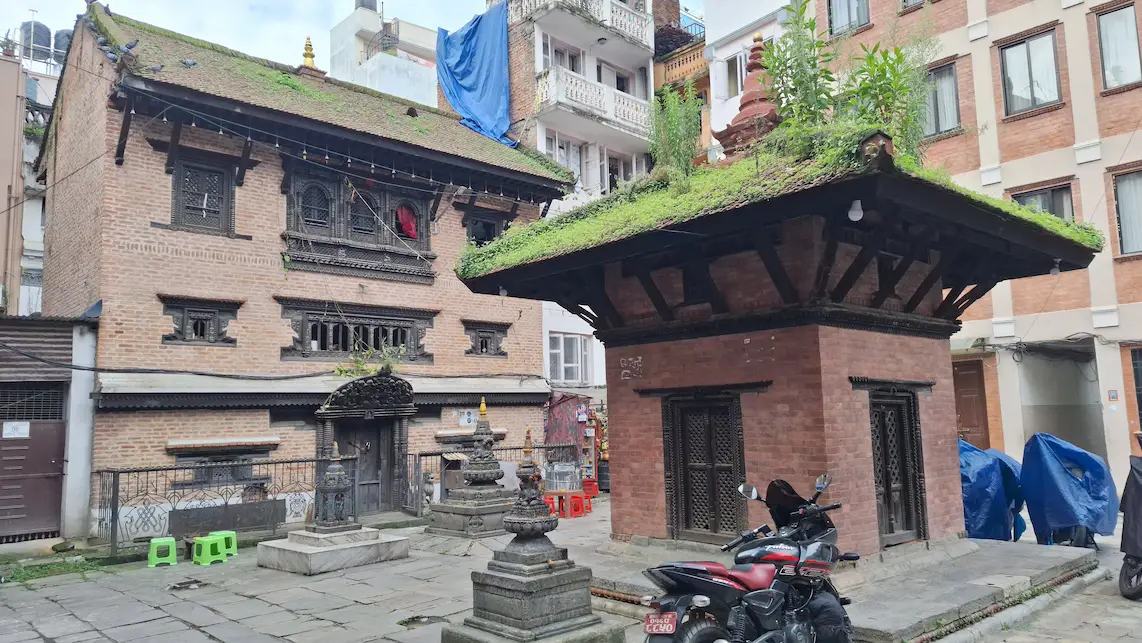
Gam Bahal today is a plain brick building of three floors standing in an enclosed courtyard.
The shrine of the Kwapa Dya (क्वापाःद्यः), the presiding deity of the monastery, is on the ground floor. Its door is very plain, and above it sits a torana (तोरण), the carved panel that goes over a doorway. This one shows Namasangiti (नामसंगीति). John K. Locke, surveying the bahal in the 1980s, recorded it as "dated N.S.1088", which works out to about 1968 CE.
Above the shrine are three tiny windows with two small openings beside them. At the level of the second floor there is a single large opening, and the rest of the front wall is plain and blank.
The courtyard is paved. Directly in front of the shrine doorway stands a single votive chaitya (चैत्य), and in front of that a much larger chaitya in its own enclosure.
The Kwapa Dya
The Kwapa Dya of Gam Bahal is an image of Akshobhya (अक्षोभ्य), facing north.
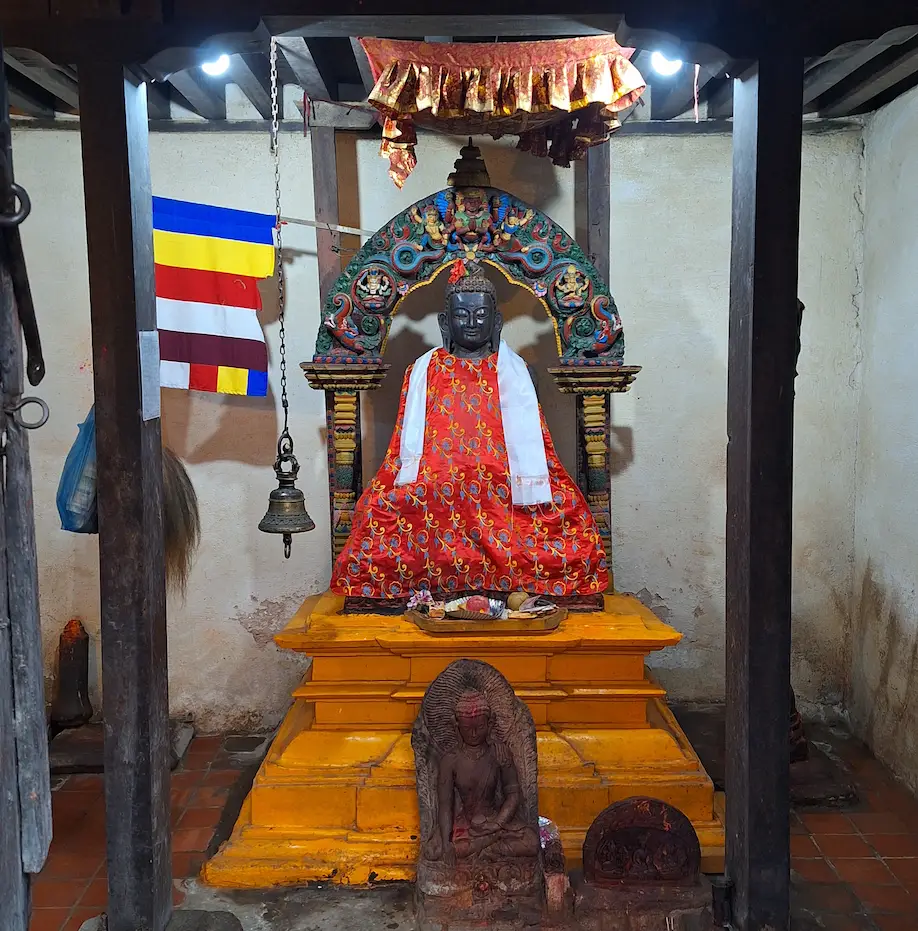
Akshobhya is one of the five transcendent Buddhas, and his name means the immovable or unshakeable one. The same deity is the Kwapa Dya of several other bahals in Kathmandu.
The land deed of N.S. 327 records that an image of Akshobhya was consecrated here in that year, and a later inscription in the courtyard records that the shrine of Akshobhya was repaired in N.S. 821. Both are covered below.
The 2015 earthquake
Gam Bahal was damaged in the Nepal earthquake of 2015. It was repaired and the work was finished in 2017.
Initiations
Both Bare Chuyegu (बरे छुयेगु) and Acha Luyegu (आचा लुयेगु) are performed at Gam Bahal for the sons of its members. These are the two ceremonies that make a boy a monk and then a man a full Bajracharya priest, and they are held only at the main bahals.
The land deed of N.S. 327
Nothing standing in the courtyard today is especially old. The monastery's claim to age rests on a document instead, and it is a remarkable one.
The members of Gam Bahal still hold a land deed from the year N.S. 327, about 1207 CE. It records that two donors gave the gift of a bahal together with land for a garden. The monastery is named in the deed as Gamthi Bahal.
On the tenth day of the month of Jyestha that year, the image of Akshobhya, the chaitya and the agam deity (आगम द्यः) were all consecrated, and the gift was handed over to two Bajracharyas and their families.
Because the deed is still in the hands of the present members, it points to a community here going back to that time, which is the strongest thing it tells us. What it does not tell us is whether Gamthi Bahal was already standing when the gift was made, perhaps abandoned or no longer needed by the people who had it before, or whether this was an entirely new foundation. The document says only that a bahal was given, not that one was built.
The later inscription
One inscription in the courtyard records two separate gifts. In N.S. 796, about 1676 CE, a golden banner was donated to the chaitya in the courtyard. In N.S. 821, about 1701 CE, the shrine of Akshobhya was repaired.
This same inscription gives the monastery's Sanskrit name as Hemavarna Mahavihar.
A note on sources and spelling
The description of the buildings, the courtyard, the land deed and the inscription draws on Buddhist Monasteries of Nepal by John K. Locke (1985).
Newar and Sanskrit words are written here in plain English letters without accent marks, with the Devanagari script given at first mention. The history in this article was made in a Sanskrit and Newar writing culture, and the original script carries meaning that plain English letters lose. Personal names and community words use the b spelling that local people use, as in Bajracharya, while Sanskrit religious terms and deity names keep the v spelling.
Nepal Samvat dates are turned into Common Era dates by adding 880 years, and Common Era dates into Nepal Samvat by subtracting 880. The equivalents given above are approximate, because the Nepal Samvat year does not line up with the Western calendar year.
This article is part of a series on the bahals of the Kathmandu Valley, and it is meant to be corrected and added to over time. If anything here is wrong, incomplete or out of date, please get in touch so it can be put right. Corrections from the sangha of the bahal itself, and from families who know these places from the inside, are especially welcome.
A short word list may help. A bahal (बहाल) is a Newar Buddhist monastery built around a courtyard, from the Sanskrit word vihara (विहार). Kwapa Dya (क्वापाःद्यः) is the presiding deity of a bahal, the main image in its shrine. Agam dya (आगम द्यः) is the secret tantric deity kept in a closed shrine. A torana (तोरण) is the carved panel above a doorway. A chaitya (चैत्य) is a small stupa, a rounded shrine built as an offering. A guthi (गुथी) is a trust that looks after a religious institution and its property.
Frequently asked questions
- What is Gam Bahal?
Gam Bahal (गम बहाल) is a Newar Buddhist monastery in central Kathmandu, one of the eighteen Acharya Guthi bahals of the Kathmandu Valley. Its Sanskrit name is Hemavarna Mahavihar.
- Where is Gam Bahal?
In a small alley between Nagha and Tyauda. You can reach it through the alley directly in front of the Si Gha Chaitya at Nagha, or through the alley between Thahiti chowk and Tyauda chowk.
- Which quarter does Gam Bahal belong to?
Thane Puin, the uptown quarter of the old city.
- How old is Gam Bahal?
Its community still holds a land deed from N.S. 327, about 1207 CE, recording the gift of the bahal and land for a garden. Nothing standing in the courtyard today is that old.
- What was the monastery called in the old deed?
Gamthi Bahal. The Sanskrit name Hemavarna Mahavihar appears later, in an inscription in the courtyard.
- What did the deed of N.S. 327 record?
That two donors gave a bahal together with land for a garden, and that on the tenth day of Jyestha that year the image of Akshobhya, the chaitya and the agam deity were consecrated and the gift handed over to two Bajracharyas and their families.
- What is the Kwapa Dya of Gam Bahal?
An image of Akshobhya, facing north, in the ground-floor shrine.
- What does the torana over the shrine show?
Namasangiti. Locke recorded its date as N.S. 1088, which works out to about 1968 CE.
- What initiations are held at Gam Bahal?
Both Bare Chuyegu and Acha Luyegu, the ceremonies that make a boy a monk and then a man a full Bajracharya priest.
- Was Gam Bahal affected by the 2015 earthquake?
Yes. It was damaged and then repaired, with the work finished in 2017.
Continue reading
Bahals and Mahavihars
Dhwaka Bahal (ध्वाका बहाल) – Henakar Mahavihar (हेनाकर महाविहार)
Bahals and Mahavihars