
Takse Bahal (तक्ष बहाल) – Suratshree Mahavihar (सुरतश्री महाविहार)
On this page
Takse Bahal (तक्ष बहाल), formally known by its Sanskrit name Suratshree Mahavihar (सुरतश्री महाविहार), is a Newar Buddhist monastery in the middle of Asan Bazar in Kathmandu – See in Map . It is one of the eighteen Acharya Guthi bahals of the Kathmandu Valley, the main monasteries overseen by the Acharya Guthi (आचार्य गुथी), the body that governs the initiated Bajracharya (बज्राचार्य) priests of the city, and it belongs to Dathu Puin, the midtown quarter of the old city.
This is the home of Surat Bajra Bajracharya (सुरत बज्र बज्राचार्य) , one of the four great Mahasiddhas of the Kathmandu Valley, and the monastery carries his name.
How to find it
Takse Bahal is tucked into a small alley in the middle of Asan Bazar, one of the busiest market squares in Kathmandu. Thousands of people pass within a few steps of it every day.
To get there, take the small alley that connects Masangalli and Balkumari – See in Map .
The courtyard and the shrine
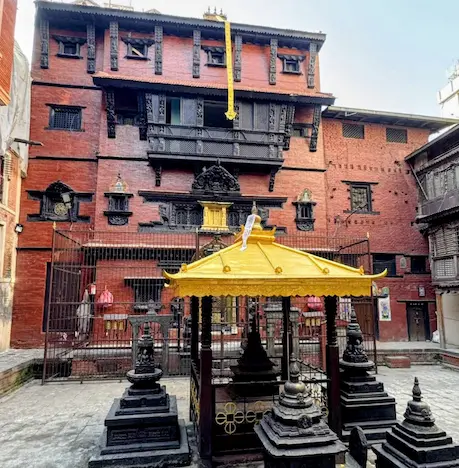
Takse Bahal sits in a small enclosed courtyard, with a shrine four floors high. The bahal has gone through a major renovation and restoration, and the building you see today is the renovated one.
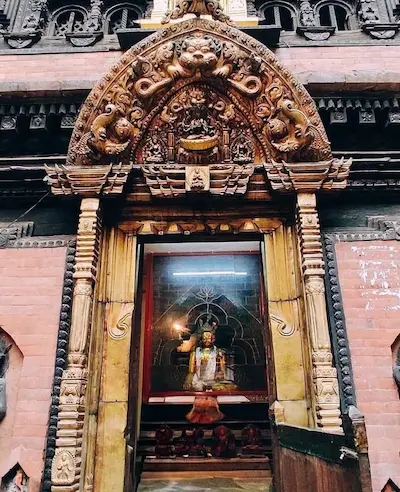
Two stone lions mark the entrance to the shrine, and each lion has a large temple bell beside it. Over the doorway is a metal torana (तोरण), the carved panel that goes above a doorway, showing Mahavairocana (महावैरोचन).
The first floor has a finely carved window with five openings, with a smaller window on each side, and above it a second torana, this one in wood, showing Mahavairocana again. The second floor has a balcony that juts out over the courtyard, held up by carved wooden struts. Above the corrugated roof over that balcony is another floor with three squat windows. Three small gajura (गजुर), the ornaments that crown a roof, sit on top.
In the courtyard stands an Ashoka Chaitya (चैत्य) under a metal canopy, along with three other votive chaityas. Inside the shrine are several images of Lokeshvara (लोकेश्वर) and one of Prajnaparamita (प्रज्ञापारमिता).
The Kwapa Dya
The Kwapa Dya (क्वापाःद्यः) of Takse Bahal, the presiding deity of the monastery, is an image of Akshobhya (अक्षोभ्य), facing north.
The Agam Dya and the Hevajra Tantra
The agam dya (आगम द्यः), the secret tantric deity of Takse Bahal, is Hevajra-Nairatmya (हेवज्र नैरात्म्या).
This is not a small detail. The Bajracharyas of this bahal have always been known as masters and teachers of the Hevajra Tantra . Takse Bahal is a Hevajra house, and it has been one for as long as anyone can trace.
The National Archives holds a copy of a commentary on the Hevajra Sadhana of Saroruha-pada, written by a Pandit Acharya Suratapada. The manuscript carries no date. It is written in Newari letters on Nepali paper, which means this copy is no older than the Malla period, and nothing is known about when the commentary itself was written or who Suratapada was.
Surat Bajra Bajracharya
Surat Bajra Bajracharya is the most famous member of this community and one of the four great Bajracharya Mahasiddhas of the Kathmandu Valley. His name comes from the Sanskrit surat (सुरत), meaning good conduct, virtue or love.
He is said to have spent part of his life in Lhasa, in Tibet, where he defeated the Dalai Lama in debate and practised the sadhana of Nairatmya in a cave outside the city. Traders who have gone to Lhasa say the cave is still there. For a long time afterwards, Tibetans would come to Takse Bahal to worship at the home of their guru.
Many believe he was born in the sixteenth century, during the reign of King Shiva Simha Malla, who ruled from 1578 to 1619. Others place him in the fifteenth century, during the reign of Jayayakshya Malla, also known as Yaksha Malla, who ruled from 1428 to 1482. That earlier dating rests on a 1490 CE inscription in Bhaktapur, dated Nepal Samvat (नेपाल संवत्) 611, which records that his son Jeeva Bajra Bajracharya was invited to Bhaktapur.
There is a great deal more to his life, his writings and his songs than belongs in an article about the building. His full story is told separately .
Who founded Takse Bahal
The monastery is named for Surat Bajra Bajracharya, but whether he founded it is a different question, and the answers do not agree.
Some say he founded it outright. Others say the bahal is much older than he is, that it was founded by another man and carried a different Sanskrit name at first, and that the name was changed afterwards to honour Surat Bajra because he renovated the monastery and brought the spiritual life of the community back to strength. A third account says the founder was an earlier man of the same name, an earlier Surat Bajra. There are hints of this earlier figure both in what the community remembers and in one manuscript reference.
What all the accounts agree on is that Surat Bajra Bajracharya made this place what it became.
Initiations
Both Bare Chuyegu (बरे छुयेगु) and Acha Luyegu (आचा लुयेगु) are performed at Takse Bahal for the sons of its members. These are the two ceremonies that make a boy a monk and then a man a full Bajracharya priest, and they are held only at the main bahals.
The connection with Mu Bahal
Takse Bahal and Mu Bahal, Mulashree Mahavihar, are closely tied to one another. The two share the same lineage deity, Guhyeshvari (गुह्येश्वरी), who in this tradition is Nairatmya, the same deity enshrined as the agam dya of Takse Bahal. The two communities also share the responsibility for keeping up the worship of the Mu Bahal Kumari (कुमारी).
The written record
The earliest dated reference to Takse Bahal is the Bhaktapur inscription of N.S. 611, about 1490 CE, which mentions Jeeva Bajra Bajracharya being called there.
An inscription at the bahal records the donation of a gajura in N.S. 760, about 1640 CE.
A manuscript of the Sri Rudrayamala Tantra from Dolakha, dated N.S. 775, about 1655 CE, was copied in that year by a Bajracharya named Munindra, who describes himself as belonging to Surata Sri Mahavihar in Asan Tole in Kantipur. This is the monastery under its Sanskrit name, and Kantipur is Kathmandu.
Another inscription records that in N.S. 840, about 1720 CE, land and a house were donated for the agam dya.
Dagu Bahal – Rangabhuvana Vihar, Bhotahiti
Dagu Bahal, one of the branches of Takse Bahal, is a small courtyard just off Bhotahiti – See in Map . All that remains of the old monastery is the shrine on the ground floor of what is otherwise an ordinary house, and even that has been replastered with cement over the brickwork. The building now has three floors, with living quarters on the upper two.
Two stone lions mark the entrance to the shrine, and the carved doorway is topped by a wooden torana showing Maha-Akshobhya. The Kwapa Dya is an image of Akshobhya, facing north. Six votive chaityas stand in the courtyard.
The earliest date available here is N.S. 804, about 1684 CE, carved on one of those votive chaityas. The foundation itself is probably a good deal older than that.
Tekan Bahal – Bodhiprasthana Vihar, Kamalakshi
Tekan Bahal, another branch of Takse Bahal, stands in a small courtyard behind the row of houses off the main street at Kamalakshi, in Ko Naya Tole.
The shrine is wedged into the southwest corner of the courtyard. Its carved doorway is topped by a wooden torana showing Dharmadhatu Vagishvara (धर्मधातु वागीश्वर). The first floor has a finely carved triple window, and above that an overhanging carved balcony with living quarters behind it. A single votive chaitya stands in front of the shrine.
The Kwapa Dya here was an image of Amoghapasha Lokeshvara (अमोघपाश लोकेश्वर). The heritage survey published as Kathmandu Valley: The Preservation of Physical Environment and Cultural Heritage, usually shortened to KTMV, gives 1651 CE, N.S. 771, as the date the bahal was built. It gives no source for that date, and there are no inscriptions in the courtyard to check it against.
Kwathu Bahal – Ashokavriksha Vihar, Asan
Kwathu Bahal, the third branch of Takse Bahal, stood at Asan. When the bahal was surveyed in the 1980s, what remained of it was two images and a chaitya kept in a small storeroom behind the shops facing the main road. The buildings had fallen into ruin, possibly in the earthquake of 1934.
The two images are an Amitabha (अमिताभ), which appears to be the Kwapa Dya saved from the ruins of the shrine, and an image of Lokeshvara. The KTMV survey dates the foundation to the sixteenth century but gives no source, and no inscriptions remain at the site.
A note on sources and spelling
The description of the buildings, the courtyard, the inscriptions and the manuscript references draws on Buddhist Monasteries of Nepal by John K. Locke (1985). The account of Surat Bajra Bajracharya draws on Prasiddha Bajracharya by Badri Ratna Bajracharya (1988) and on the material gathered at Bajracharya.org.
Newar and Sanskrit words are written here in plain English letters without accent marks, with the Devanagari script given at first mention. The history in this article was made in a Sanskrit and Newar writing culture, and the original script carries meaning that plain English letters lose. Personal names and community words use the b spelling that local people use, as in Bajracharya and Surat Bajra, while Sanskrit religious terms and deity names keep the v spelling, as in Mahavairocana.
Nepal Samvat dates are turned into Common Era dates by adding 880 years, and Common Era dates into Nepal Samvat by subtracting 880. The equivalents given above are approximate, because the Nepal Samvat year does not line up with the Western calendar year.
This article is part of a series on the bahals of the Kathmandu Valley, and it is meant to be corrected and added to over time. If anything here is wrong, incomplete or out of date, please get in touch so it can be put right. Corrections from the sangha of the bahal itself, and from families who know these places from the inside, are especially welcome.
A short word list may help. A bahal (बहाल) is a Newar Buddhist monastery built around a courtyard, from the Sanskrit word vihara (विहार). Kwapa Dya (क्वापाःद्यः) is the presiding deity of a bahal, the main image in its shrine. Agam dya (आगम द्यः) is the secret tantric deity kept in a closed shrine. A torana (तोरण) is the carved panel above a doorway. A chaitya (चैत्य) is a small stupa, a rounded shrine built as an offering. A gajura (गजुर) is the ornament that crowns a roof. A sadhana is a set practice of meditation on a particular deity. A guthi (गुथी) is a trust that looks after a religious institution and its property.
Frequently asked questions
- What is Takse Bahal?
Takse Bahal (तक्ष बहाल) is a Newar Buddhist monastery in Asan Bazar, Kathmandu, one of the eighteen Acharya Guthi bahals of the Kathmandu Valley. Its Sanskrit name is Suratshree Mahavihar.
- Where is Takse Bahal?
In a small alley in the middle of Asan Bazar. Take the alley that connects Masangalli and Balkumari.
- Which quarter does Takse Bahal belong to?
Dathu Puin, the midtown quarter of the old city.
- Who was Surat Bajra Bajracharya?
One of the four great Bajracharya Mahasiddhas of the Kathmandu Valley and the most famous member of this community. The monastery carries his name. His full story is told in a separate article.
- Did Surat Bajra Bajracharya found Takse Bahal?
Accounts differ. Some say he founded it. Others say the bahal is older and was renamed in his honour after he renovated it and revived the community. A third account says the founder was an earlier man of the same name.
- What is the Kwapa Dya of Takse Bahal?
An image of Akshobhya, facing north.
- What is the agam dya of Takse Bahal?
Hevajra-Nairatmya. The Bajracharyas of this bahal have long been known as masters and teachers of the Hevajra Tantra.
- What initiations are held at Takse Bahal?
Both Bare Chuyegu and Acha Luyegu, the ceremonies that make a boy a monk and then a man a full Bajracharya priest.
- When does the written record of Takse Bahal begin?
With a Bhaktapur inscription of N.S. 611, about 1490 CE. An inscription records a gajura donated in N.S. 760, about 1640 CE, and a manuscript of N.S. 775, about 1655 CE, names a Bajracharya of Surata Sri Mahavihar in Asan Tole.
- How is Takse Bahal connected to Mu Bahal?
The two share the same lineage deity, Guhyeshvari, who in this tradition is Nairatmya, and they share the responsibility for keeping up the worship of the Mu Bahal Kumari.
- What are the branches of Takse Bahal?
Dagu Bahal (Rangabhuvana Vihar) at Bhotahiti, Tekan Bahal (Bodhiprasthana Vihar) at Kamalakshi, and Kwathu Bahal (Ashokavriksha Vihar) at Asan.
Continue reading
Bahals and Mahavihars
Gam Bahal (गम बहाल) – Hemavarna Mahavihar (हेमवर्ण महाविहार)
Bahals and Mahavihars