
Jana Bahal (जन बहाल) – Kanak Chaitya Mahavihar (कनक चैत्य महाविहार)
On this page
Jana Bahal (जन बहाल), formally known by its Sanskrit name Kanak Chaitya Mahavihar (कनक चैत्य महाविहार), is a Newar Buddhist monastery at Kel Tole in Kathmandu, about halfway between Asan and Indrachowk and close to Masangalli – See in Map . It is one of the eighteen Acharya Guthi bahals of the Kathmandu Valley, the main monasteries overseen by the Acharya Guthi (आचार्य गुथी), the body that governs the initiated Bajracharya (बज्राचार्य) priests of the city, and it belongs to Dathu Puin, the midtown quarter of the old city.
It is best known as the home of the White Karunamaya (करुणामय) , Arya Lokeshvara (आर्य अवलोकितेश्वर), called Jana Baha Dya (जन बहा द्य:) in Newar. This is one of the four Lokeshvara of the Kathmandu Valley, and the Jana Baha Dya chariot festival is one of the great annual events of the city.
How to find it
Jana Bahal sits at Kel Tole, in the stretch of market between Asan and Indrachowk – See in Map . The courtyard can be entered from all four sides, each through a small alley off the surrounding streets. The main entrance is the one across from Masangalli.
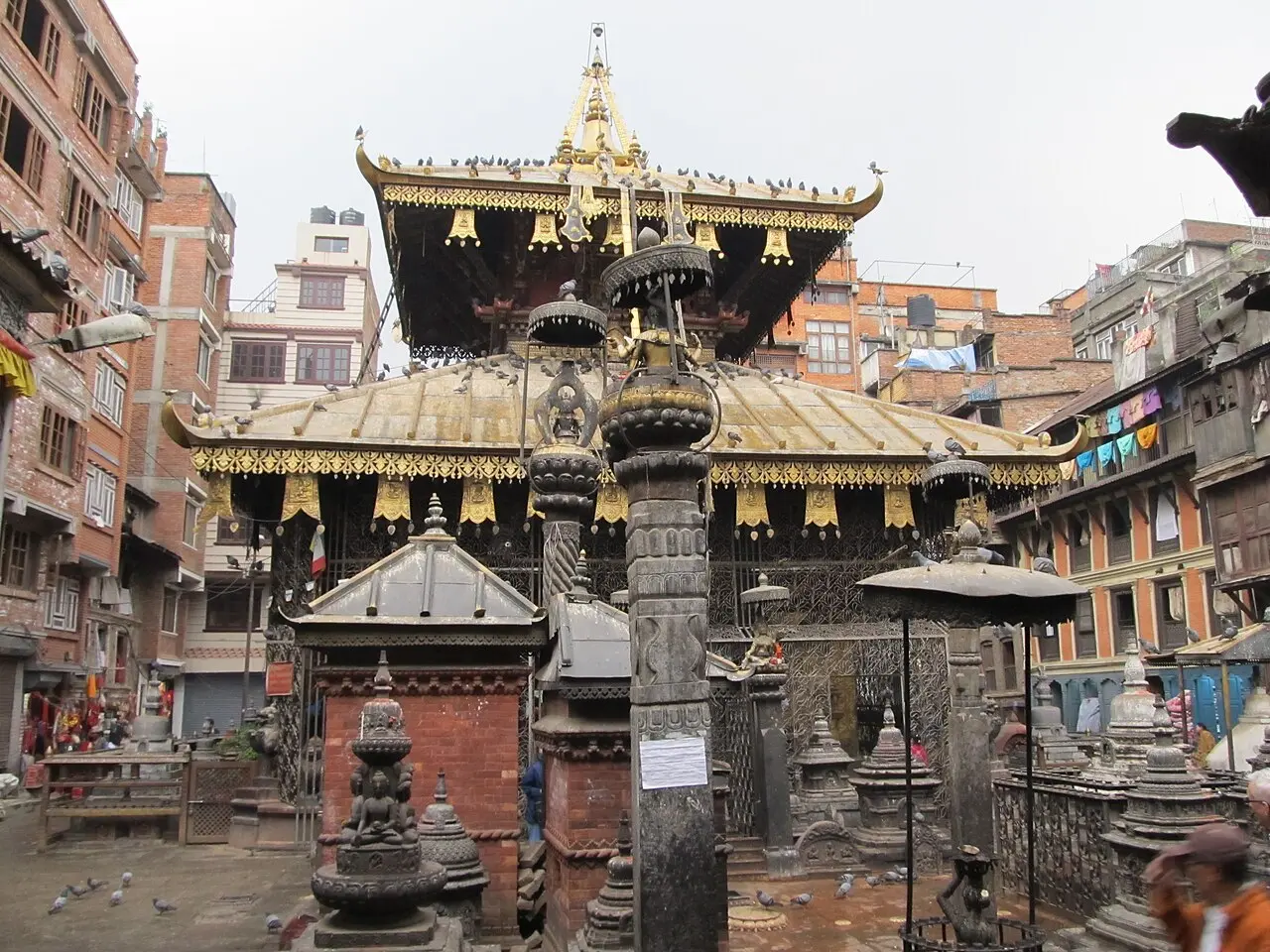
The main doorway faces the open area of Kel Tole, and a pillar stands in front of it carrying two images back to back, Amitabha (अमिताभ) on one side and Akshobhya (अक्षोभ्य) on the other. A stone mandala (मण्डल) is set into the pavement near the pillar.
The entrance and the courtyard
The front entrance standing today was rebuilt and completed in 2026, following the design of the entrance it replaced.
That older entrance went back to 1917, when a fire destroyed the original entryway and most of the buildings along the south side of the inner compound. An inscription records the repairs that followed, made in the year 1974 Bikram Sambat, which is 1918 to 1919 CE. It was built in white plaster in what people here call Rana style, and it sat oddly against everything around it. The Newar facade lost in the fire had carried a beautifully carved triple window over the doorway and a fine wooden torana (तोरण), the carved panel that goes above a doorway.
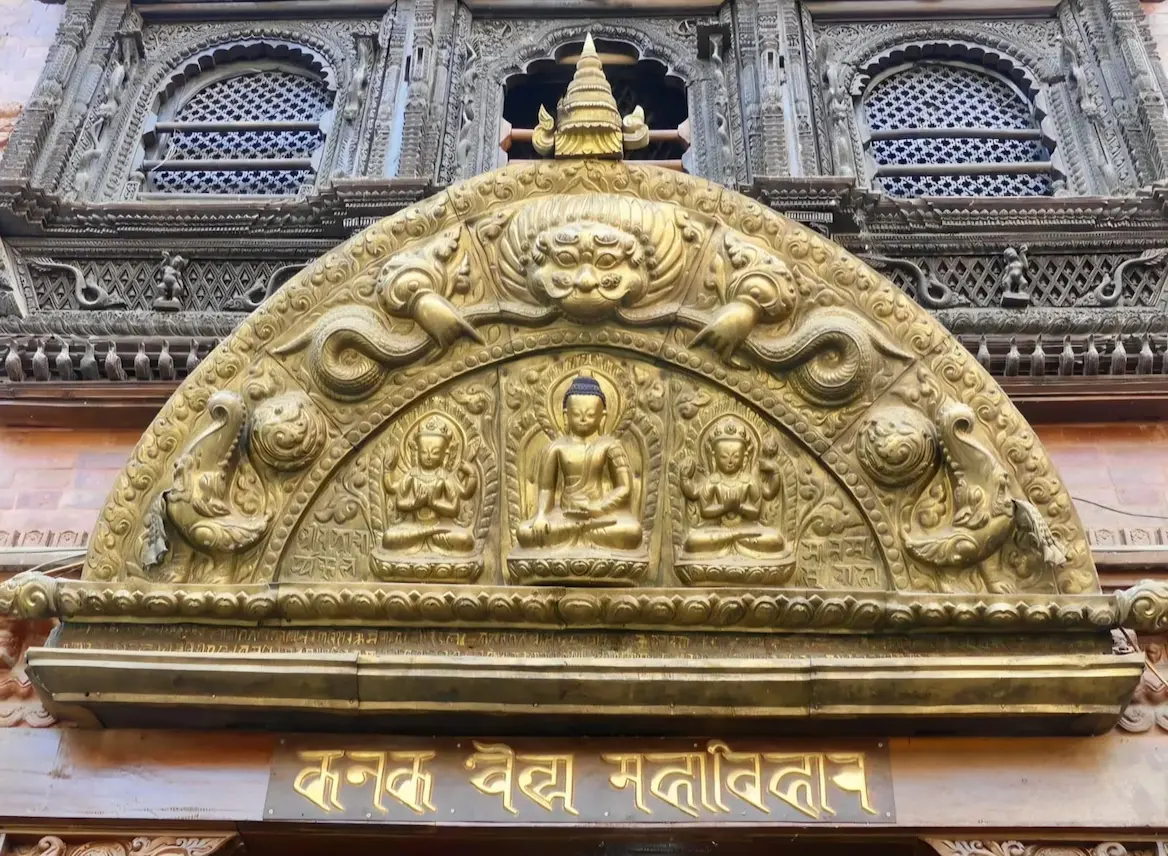
Through the doorway is a long vestibule leading to the inner courtyard. On the right side of it is a platform where devotees gather to sing bhajans morning and evening.
The Kwapa Dya
The Kwapa Dya (क्वापाःद्यः) of Jana Bahal, the presiding deity of the monastery, is a large brass image of Akshobhya, facing west. The shrine is just to the right of the entryway as you come into the courtyard.
At most bahals the Kwapa Dya is the deity before whose shrine all the main rites of the sangha are performed. At Jana Bahal that place has been taken by Lokeshvara. All the rites and feasts of the sangha are held before that shrine instead, and the shrine of the Kwapa Dya is opened once a day for a short puja by the dya-pala (द्यःपाला) on duty, who otherwise serves in the shrine of Lokeshvara.
Everywhere else that Lokeshvara resides, Lokeshvara is the Kwapa Dya of that place. This is true at Bungamati in Patan, at Chobhar, at Nala, at Bhaktapur, at Thimi and at Tanga Bahal in Patan. At Jana Bahal it is not so. Akshobhya holds that position.
The temple of Jana Baha Dya
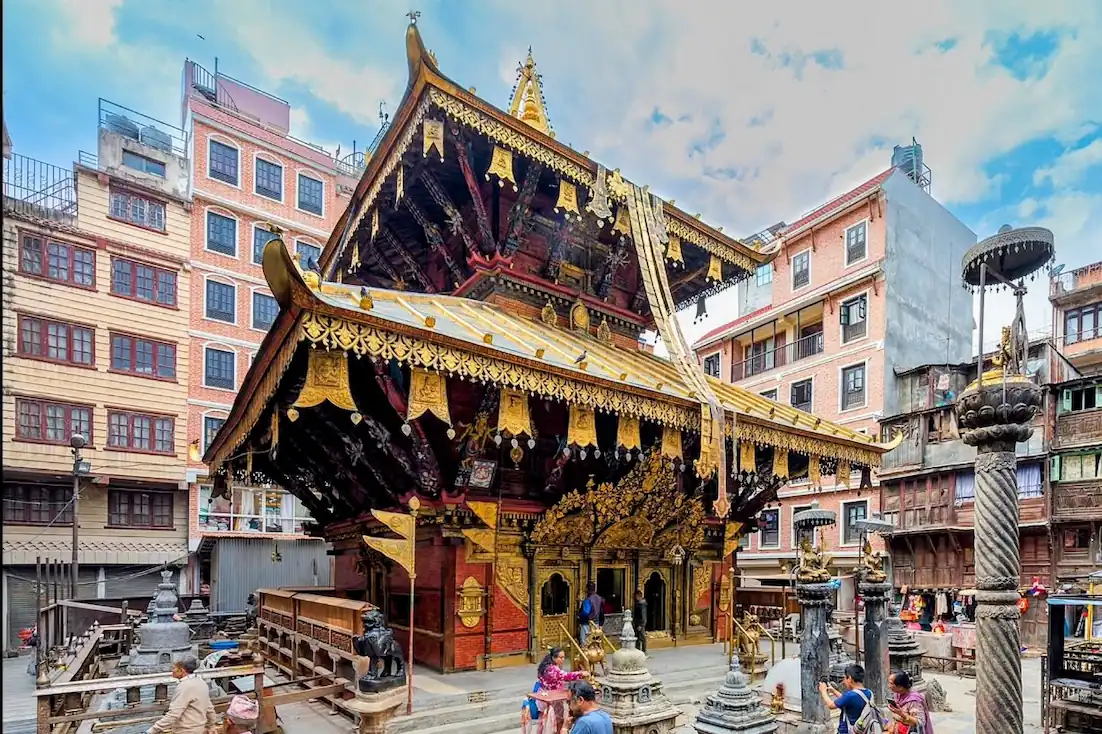
The temple of Jana Baha Dya stands free in the courtyard, a squat building of two roofs, richly decorated. It was rebuilt during the restoration that followed the 2015 earthquake and was completed in 2026, following the design of the temple it replaced.
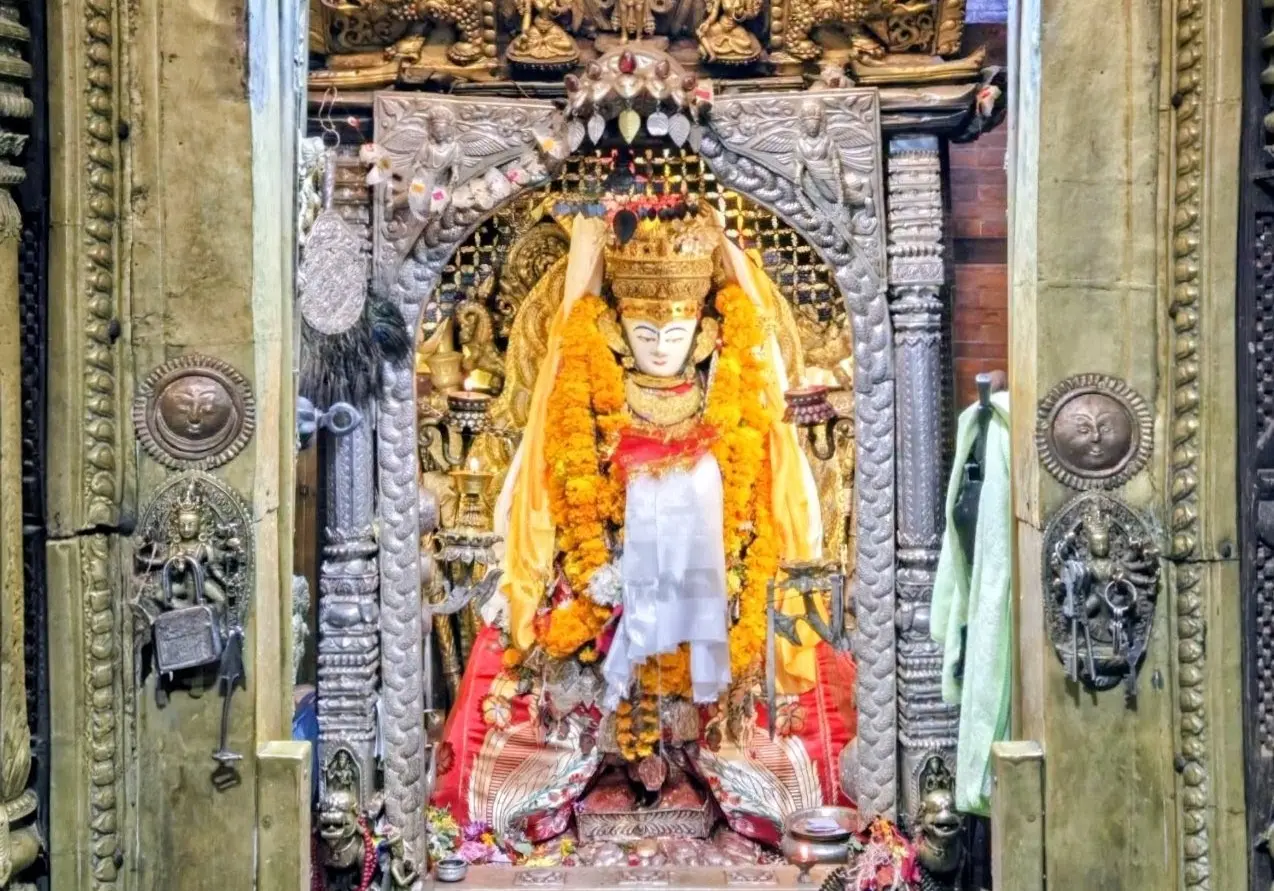
The image housed in this temple is Arya Lokeshvara (आर्य अवलोकितेश्वर), the White Karunamaya, called Jana Baha Dya in Newar. This is the deity people come here to see, described in full further down.
The main entrance is a triple doorway under a large torana in three sections. The whole front is covered with Buddhist figures, and each of the other three doors into the temple has a repousse torana of its own.
From each of the two gilt copper roofs hangs a row of gilded copper repousse banners called halampo, and these give the temple its distinctive look from a distance. The struts holding up the two roofs are carved with different many-armed forms of Avalokiteshvara.
The upper roof is crowned by two small finials and one large one, with a triple umbrella above them. Just in front of the main finial is a large darpana (दर्पण) bearing the vishvavajra (विश्ववज्र), with a kalasha (कलश) on either side, each holding a lotus.
Credit: Aishu Mathema
The image of Jana Baha Dya
The deity in this temple is Arya Lokeshvara (आर्य अवलोकितेश्वर), the White Karunamaya, called Jana Baha Dya in Newar. The name means the Noble One who Observes the World. This is one of the four Lokeshvara of the Kathmandu Valley, white in colour, standing for purity and boundless compassion.
The image is white and stands about four feet high, upright on a lotus and bare to the waist. The right hand is open at the side in varada mudra (वरद मुद्रा), the gesture of giving, with a mark on the open palm, and the left is held as if to hold a lotus.
The face is calm, with the eyes half closed and lowered, arched brows, and a small red mouth. A golden tika is set at the centre of the forehead. The hair is piled on the head in the jataka mukuta, with a figure of Amitabha (अमिताभ) painted at the centre of it, and gold ornaments hang at the ears. The image carries the ornaments of a bodhisattva, the sacred thread across the chest, the shrivatsa or endless knot in gold on the chest, and the swastika at the navel. Gold bands circle the wrists and the ankles. The only garment painted on the image is a dhoti. A small Tara (तारा) stands on either side, one green and one white.
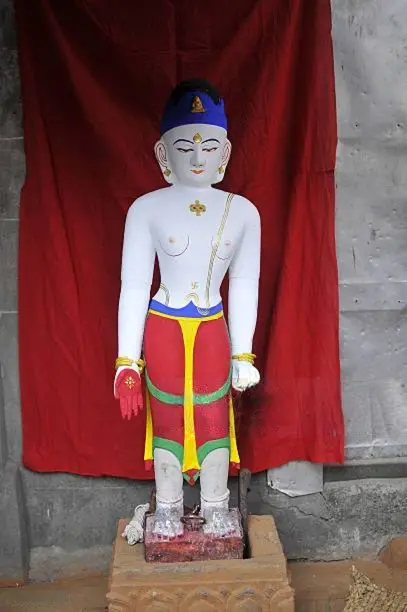
The description above is of the image itself. A visitor to the shrine does not see it that way. There the image is covered from the neck down in garments, flower garlands and ornaments, layer upon layer of them, so that all anyone can see is the face. Above it rises a tall gilded crown worked in repousse, with a pale stone set at its peak, and behind the head is a gilded aureole of flame-like scrollwork. A broad gilded collar sits at the neck, and below it hang strands of red coral beads, silver chains and small votive ornaments given by devotees over the years. A pale blue silk scarf is draped over the shoulders, marigold garlands in orange and yellow hang to the waist, and the figure widens below into a skirt of red and gold cloth reaching the floor of the shrine. Oil lamps burn to the left and right, and the whole shrine is framed in worked metal.
The Kanak Chaitya
Directly in front of the main door of the temple stands a small plastered chaitya (चैत्य). This is the Kanak Chaitya, and the monastery takes its name from it.
Because it is replastered from time to time, it now looks like nothing more than a white shapeless mound. Its size, and what can be seen of the tip, suggest that a Licchavi (लिच्छवि) chaitya may be underneath. The rest of the courtyard around the temple is crowded with images and with thirty-one votive chaityas.
The chariot festival and the bathing
The two great annual events at Jana Bahal are the bathing of Jana Baha Dya and the chariot festival. Together they make Jana Baha Dya Jatra one of the two great chariot festivals of Kathmandu, the other being Kumari Jatra.
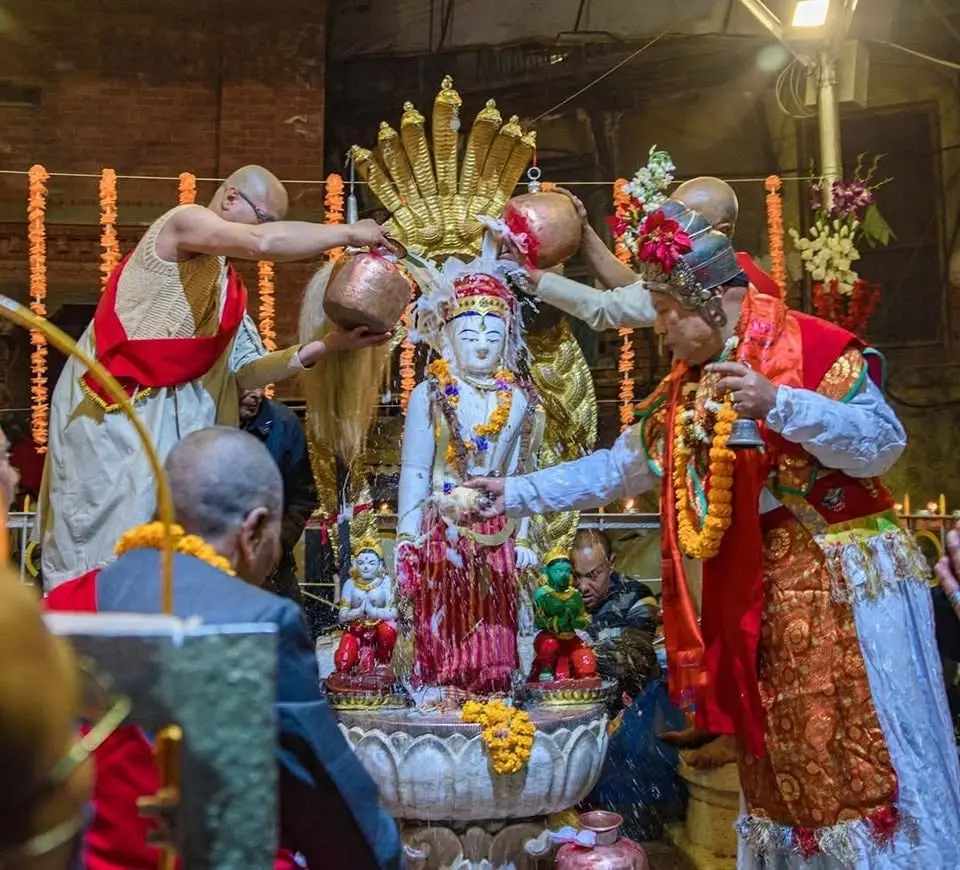
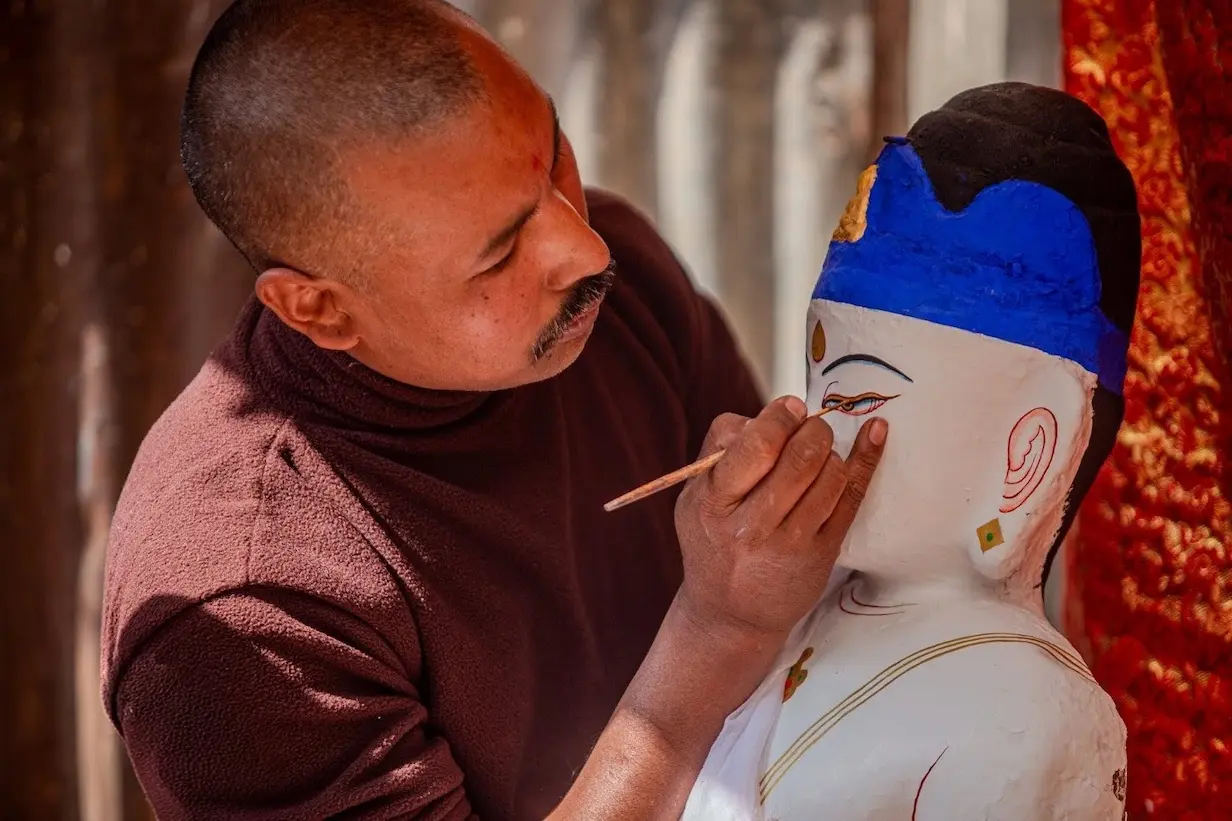
The bathing takes place on the eighth day of the bright half of Paush, in winter. Before the washing, the spirit of the deity is removed from the image. The chief priest first worships the ten dikpalas, the guardians of the ten directions, and the deity is then bathed with holy water kept for the purpose, to the playing of the panchatala baja. Afterwards the image is set to one side of the courtyard and repainted over the following days, then reconsecrated in an all-night ceremony on the full moon day of Paush.
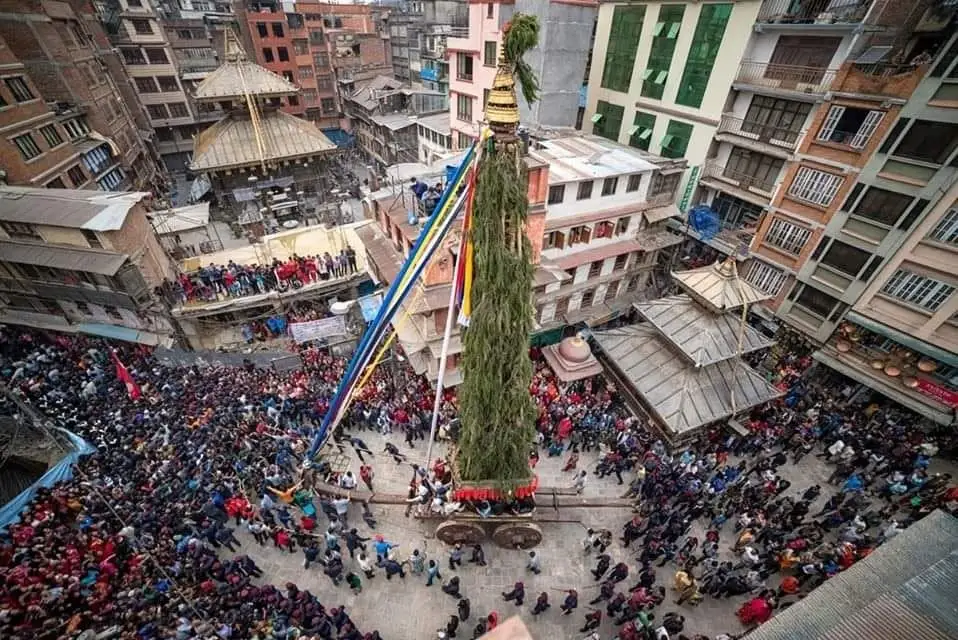
The chariot festival begins on the eighth day of the bright half of Chaitra, which falls in late March or April. The image is carried out of Jana Bahal on a palanquin to Jamal, where the tall wooden chariot is built fresh each year. From there it is pulled through the old city over several days.
The first day takes the chariot from Jamal through Bhotahiti to Asan, where it halts overnight. The second takes it from Asan through Indrachowk and Makhan to Hanumandhoka. The third carries it on through Maru, Chikanmugal and Jaisideval to Lagan, at the southern end of the old city. At Lagan the chariot circles the shrine of the deity's mother, and the Kumari (कुमारी) comes to see the deity there.
When the procession is finished, a shantisvasti puja is performed to settle the deity in case of any offence given along the way, and the image is carried back to Jana Bahal on a palanquin. A feast for the whole sangha closes the festival, and this feast is the annual festival of the sangha.
Jana Bahal is also one of the favourite places in the city for the monthly Ashtami Vrata in honour of Amoghapasha Lokeshvara. On the eighth day of the bright half of any month, large groups gather here for it.
Initiations
Both Bare Chuyegu (बरे छुयेगु) and Acha Luyegu (आचा लुयेगु) are performed at Jana Bahal for the sons of its members. These are the two ceremonies that make a boy a monk and then a man a full Bajracharya priest, and they are held only at the main bahals.
Acha Luyegu always follows four days after Bare Chuyegu.
At most bahals the priests are Bajracharyas. At Jana Bahal they come from both Bajracharya and Shakya families, and both serve.
The guthis of Jana Bahal
Because of the importance of Jana Baha Dya, Jana Bahal has more guthis (गुथी) than most monasteries. A guthi is a trust that takes charge of a religious duty and the property attached to it.
The members of the sangha together form a guthi whose job is to look after the bahal and to serve as dya-pala in the shrine of Jana Baha Dya. There is a guthi fund registered with the government Guthi Samsthan, and its income pays the priest on duty. The permanent ornaments of the deity are registered with the government guthi office as well, although the ornaments themselves were given by private families, and it falls to the priest serving in the temple to keep them safe. This guthi holds an annual meeting with a puja and a feast at the close of the chariot festival.
Besides the registered one, there are several private guthis for particular tasks. One is responsible for the fixtures of the chariot: getting them out of storage before the festival, making sure they are fit to be mounted, then collecting them from the chariot at Lagan Tole afterwards and putting them away for the next year. When the job is done, they hold a feast. Another guthi looks after the lighting and care of a large oil lamp called the mahadipa, lit during the annual bathing and on a few other important occasions. A third is responsible for the disi puja at the two solstices.
Where the image came from
The chronicles say the image of Lokeshvara was brought to Kanak Chaitya Mahavihar from Jamal. The tradition kept at Jana Bahal itself says the monastery was already here before the image arrived.
There is good reason to think so. Before the image came, the way into the compound was from the west, which would have put the shrine of the Kwapa Dya and the agam shrine of the sangha directly opposite the entrance, as they are at every other bahal. That western entryway still exists, though it is little used now. When the image was brought and a temple built for it, it was decided that the deity should face east, and a new entrance was cut so that a visitor comes in facing the temple.
The separate Akshobhya shrine points the same way. If the image of Lokeshvara had been here from the start, or if the monastery had been founded to house that image, Lokeshvara would be the Kwapa Dya, as is the case everywhere else Lokeshvara resides.
The written record
The earliest date found at Jana Bahal is on a painting of Herukachakrasamvara and his consort, kept in the agam and dated N.S. 521, about 1401 CE, which falls in the joint reign of the three sons of Jayasthiti Malla. That gives some sign that the bahal existed then.
Everything else datable comes from the time of Yaksha Malla onward. A manuscript copy of the Pancharaksha in the government library, dated N.S. 590, about 1470 CE, was copied by a Bajracharya named Manikaraja Candra of Sri Kamalaganthi in Koligrama. Koligrama is the area of Kathmandu around Kel Tole, and the guthi records of the sangha do use the name Kamalaganthi for the bahal.
The guthi of the sangha holds a number of old records, mostly about its internal affairs: donations, loans taken by members from the funds, and so on. A loan was given to a member in Baisakh N.S. 639, about 1519 CE, in the reign of Ratna Malla, son of Yaksha Malla. An entry of N.S. 679, about 1559 CE, mentions vessels made for the sangha by a Kamsakar, in the reign of Narendra Malla. In N.S. 770, about 1650 CE, repairs were made to the rest house below the agam. None of these records mentions Lokeshvara.
Every reference after that does. A bracelet worn by the image was donated in the reign of Lakshminarasimha, who ruled from 1619 to about 1641 CE, and this is the oldest datable thing in the compound that certainly refers to the presence of Lokeshvara. Two old wooden toranas, one now inside the temple and the other hanging over the entryway door, were given in the time of Lakshminarasimha and Pratap Malla, about 1641 CE. The earliest stone inscription in the courtyard is from Pratap Malla's time.
The later inscriptions all name the deity Jamaleshvara, the Lord of Jamal, which is strong support for the tradition that the image came from there. An inscription on the step below a chaitya on the east side records a bell donated in N.S. 779, about 1659 CE, dedicated to Chintamani Lokeshvara at the temple of Jamaleshvara in Kanak Chaitya Mahavihar in the city of Kantipur, given by Candra Simha Bharo of Kel Tole. An inscription on the north side, dated N.S. 784, about 1664 CE, records a donation by a Tuladhar of Asan Tole at the same shrine. On the east side, another chaitya was put up as a memorial by Dharmaraja Kamsakar Bharo in N.S. 796, about 1676 CE, in the reign of Nripendra Malla. Another, on the north side, dates to N.S. 800, about 1680 CE, also under Nripendra Malla. A further chaitya was raised north of the temple in N.S. 830, about 1710 CE, in the reign of Bhaskara Malla.
The age of the chariot festival
There is no reliable evidence about when the chariot festival of Lokeshvara began, or when it was revived. Some chronicles say there was a chariot festival in ancient times which lapsed and was later brought back, and some credit Pratap Malla with starting it. The second claim can be ruled out.
A thyasaphu, a traditional Newar notebook chronicle, records that in N.S. 747, about 1627 CE, in the time of Lakshminarasimha, the chariot of Jamala-deva fell over at Jya Bahal while it was being pulled towards Lagan. Another reference, of N.S. 750, about 1630 CE, says Lakshminarasimha lengthened the route of the chariot by adding a stop at Swakambu, in the Hanumandhoka area.
So the festival was already a going concern in 1627 CE, before Pratap Malla's reign. The latest king who could possibly have started it is Lakshminarasimha, his father. From 1627 to the present day, the custom has been kept up without a break.
A note on sources and spelling
The description of the buildings, the courtyard, the guthis, the inscriptions and the manuscript references draws on Buddhist Monasteries of Nepal by John K. Locke (1985). The account of Arya Lokeshvara and the four Lokeshvara of the Valley draws on the material gathered at Bajracharya.org.
Newar and Sanskrit words are written here in plain English letters without accent marks, with the Devanagari script given at first mention. The history in this article was made in a Sanskrit and Newar writing culture, and the original script carries meaning that plain English letters lose. Personal names and community words use the b spelling that local people use, as in Bajracharya, while Sanskrit religious terms and deity names keep the v spelling, as in Avalokiteshvara.
Nepal Samvat dates are turned into Common Era dates by adding 880 years, and Common Era dates into Nepal Samvat by subtracting 880. Bikram Sambat dates are turned into Common Era dates by subtracting about 57 years. The equivalents given above are approximate, because neither year lines up with the Western calendar year.
This article is part of a series on the bahals of the Kathmandu Valley, and it is meant to be corrected and added to over time. If anything here is wrong, incomplete or out of date, please get in touch so it can be put right. Corrections from the sangha of the bahal itself, and from families who know these places from the inside, are especially welcome.
A short word list may help. A bahal (बहाल) is a Newar Buddhist monastery built around a courtyard, from the Sanskrit word vihara (विहार). Kwapa Dya (क्वापाःद्यः) is the presiding deity of a bahal, the main image in its shrine. Agam (आगम) is the secret tantric shrine of a sangha. A torana (तोरण) is the carved panel above a doorway. A chaitya (चैत्य) is a small stupa, a rounded shrine built as an offering. Repousse means metalwork hammered into relief from the back. A ratha jatra is a chariot festival. A guthi (गुथी) is a trust that looks after a religious duty and the property attached to it. A thyasaphu is a traditional Newar folding notebook, often used to record events.
Frequently asked questions
- What is Jana Bahal?
Jana Bahal (जन बहाल) is a Newar Buddhist monastery at Kel Tole in Kathmandu, one of the eighteen Acharya Guthi bahals of the Kathmandu Valley. Its Sanskrit name is Kanak Chaitya Mahavihar. The monastery was damaged in the 2015 earthquake and restored over the following decade, with the work completed in 2026.
- Where is Jana Bahal?
At Kel Tole, about halfway between Asan and Indrachowk. The courtyard has an entrance on each of its four sides, every one of them through a small alley. The main entrance is the one across from Masangalli, facing the open area of Kel Tole.
- Who is Jana Baha Dya?
The White Karunamaya, Arya Lokeshvara, one of the four Lokeshvara of the Kathmandu Valley. This is the deity of the free-standing temple in the courtyard and the centre of the monastery's religious life.
- Why is it called Kanak Chaitya Mahavihar?
From the Kanak Chaitya, the small chaitya standing directly in front of the temple door. It is replastered from time to time and looks like a white mound, but a Licchavi chaitya may lie underneath.
- What is the Kwapa Dya of Jana Bahal?
A large brass image of Akshobhya, facing west, in a shrine to the right of the entryway. The rites of the sangha are held before Lokeshvara instead, and the Kwapa Dya shrine is opened once a day for a short puja.
- Is Jana Bahal older than its famous image?
The evidence says yes. The way in was once from the west, which would have put the Kwapa Dya shrine opposite the entrance in the usual way, and that old western entryway still exists. If the monastery had been founded to house Lokeshvara, Lokeshvara would be the Kwapa Dya, as is the case everywhere else Lokeshvara resides.
- Was Jana Bahal affected by the 2015 earthquake?
Yes. The restoration took close to a decade and was completed in 2026. The front entrance and the main temple were both rebuilt in that work, following the designs they replaced.
- Who serves as priest at Jana Bahal?
At most bahals the priests are Bajracharyas. At Jana Bahal they come from both Bajracharya and Shakya families, and both serve.
- When is the chariot festival?
It begins on the eighth day of the bright half of Chaitra, in late March or April. The chariot is built at Jamal and pulled over several days through Bhotahiti to Asan, then to Hanumandhoka, then to Lagan, where the chariot circles the shrine of the deity's mother and the Kumari comes to see the deity.
- How old is the chariot festival?
It was already an established custom in 1627 CE. Records from that year and from about 1630 CE place it in the reign of Lakshminarasimha, which rules out the claim that Pratap Malla started it.
- When does the written record of Jana Bahal begin?
With a painting of Herukachakrasamvara dated N.S. 521, about 1401 CE. A manuscript of N.S. 590, about 1470 CE, names the bahal as Kamalaganthi in Koligrama, the area around Kel Tole.
- What initiations are held at Jana Bahal?
Both Bare Chuyegu and Acha Luyegu, with Acha Luyegu four days after Bare Chuyegu.
Continue reading
Bahals and Mahavihars
Takse Bahal (तक्ष बहाल) – Suratshree Mahavihar (सुरतश्री महाविहार)
Bahals and Mahavihars