
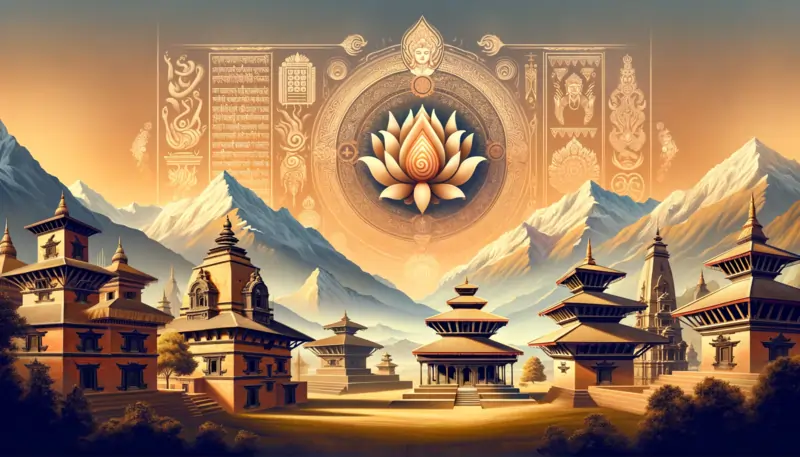
Guardians of Vajrayana: The Esteemed Bajracharya Priests
Bajracharyas are the revered married priests within Nepal’s Newar community, known for their profound understanding of the Newar Buddhist Vajrayana traditions. Holding the highest rank among Newar Buddhist castes, they serve as the keepers of ancient spiritual practices. Their role as custodians of Buddhist rituals and teachings is not just a job; it’s a way of life, handed down through generations and steeped in deep spiritual significance.
Mythological Foundations: Manjushri’s Legacy
The mythological roots of the Bajracharya lineage are as fascinating as they are ancient. Guruju Badri Ranta Bajracharya’s writings reveal that the first Bajracharya was Manju Dev Acharya, also known as Manjushri. This legendary figure is said to have traveled from the Panchasirsa hillock of Great China in Treta Yuga (Second Era, hundreds of thousands of years ago, based on Swayambhu Purana), bringing with him profound spiritual knowledge and practices. Upon his arrival in ancient Nepal, Manju Dev Acharya drained the holy lake of Nagarasahrada, laid the foundations of Nepal Mandal, and introduced Buddhism to the region. His actions didn’t just reshape the geography; they set in motion a spiritual tradition that would endure for centuries.
Ancestral Memory: Shantikar Acharya
Bridging the space between myth and history, the story of Shantikar Acharya has been preserved through generations of oral tradition within the Bajracharya community. According to these deeply respected accounts, a royal figure named King Prachanda Dev, from Gauda (present-day Bengal, India), traveled to Nepal during the Dvapara Yuga (Third Era, hundreds of thousands of years ago, as described in the Swayambhu Purana). His journey was inspired by a desire to pay homage to the Swayambhu Dharmadhatu — a radiant, eternal flame said to rise from a lotus sown by the first Buddha, Vipaswi.
Upon witnessing this sacred flame, Prachanda Dev is said to have undergone a powerful spiritual awakening. Moved by its presence, he renounced his throne and chose the path of a Vikshu (monk). Under the guidance of Gunakar Acharya, he received Acharyabhishek, a ritual ordination, and took on the name Shantikar Acharya (also known as Shantikaracharya). Within this narrative, he is remembered as the first formal Bajracharya, initiating a sacred lineage of Vajrayana Buddhist priests.
As a final act of devotion, Shantikar Acharya is believed to have overseen the enshrinement of the Swayambhu Dharmadhatu within the Swayambhu Maya Chaitya, sealing its luminous power in a form that could be preserved for future generations.
Though not supported by archaeological evidence, this story remains an integral part of Bajracharya ancestral memory — a testament to the spiritual roots and cultural depth that continue to define their tradition.
Historical Master: Wak Bajra Bajracharya of the 5th Century
Among the Bajracharya lineage, Wak Bajra Bajracharya stands out as the earliest historically documented figure, dating back to the 5th century CE. His life and contributions are tied to Kwa-Bahal (Maitripur Mahavihar) in Kathmandu, one of the oldest and most revered monastic courtyards in the valley.
Historical accounts recognize Wak Bajra Bajracharya for his pivotal role in establishing Maitripur Mahavihar as a spiritual and scholastic center for Vajrayana Buddhism. He is especially remembered for constructing the Si Gha Chaitya, a sacred stupa whose origin story is steeped in spiritual awe. According to traditional narratives, this feat was accomplished through his advanced meditative powers — with some accounts describing him levitating from Kasi (present-day Varanasi, India) to Kathmandu to complete the construction.
Wak Bajra Bajracharya was also a prolific scholar. He is credited with authoring several significant Buddhist scriptures, including the respected text Rakta Varna. His commitment to deep meditation and spiritual practice is so revered that it is said he remains in an eternal meditative state within Kwa Bahal to this day — a symbolic testament to the depth of his spiritual mastery.
As the oldest known Bajracharya in historical records, Wak Bajra Bajracharya represents the tangible anchor between Nepal’s early Buddhist history and the living Bajracharya tradition that continues in the present.
Genetic Roots Revealed: DNA Testing of the Bajracharya Lineage
In recent years, modern science has begun to confirm what ancient stories have long hinted at: the Bajracharya lineage is not just spiritual but genetically diverse and historically rich. Bajracharya.org conducted DNA analysis with over 20+ Bajracharya individuals has revealed a fascinating dual heritage — approximately 70–80% of their genetic makeup aligns with populations in the current Tibetan region, and 20–30% traces back to the Bengal region.
The strong Tibetan connection is unsurprising. Known in ancient times as Bhota or Lhasa, Tibet was a major center of Vajrayana Buddhism, and for centuries, Bajracharyas journeyed across the treacherous Himalayan passes to teach, learn, and trade. Between the 7th and 14th centuries, there was a flourishing exchange of monks, texts, and art between Nepal and Tibet. Bajracharya teachers were welcomed in Lhasa’s monasteries, and Tibetan scholars found a second home in the monastic courtyards of the Kathmandu Valley. These exchanges shaped not only religious doctrine but also language, iconography, and ritual practice — a spiritual symbiosis reflected even in the bloodlines of today’s Bajracharyas.
But the Bengal connection is more intriguing — and perhaps, more telling of a forgotten chapter of history. During the 8th to 12th centuries CE, the Pala Empire, ruling over present-day Bengal and Bihar, was one of the greatest patrons of Mahayana and Vajrayana Buddhism. Under kings like Dharmapala and Devapala, Bengal flourished as a Buddhist heartland, home to world-renowned Buddhist universities like Nalanda, Vikramashila, and Odantapuri. These monastic institutions were not mere schools — they were international hubs of learning that attracted students and teachers from across Asia, including Nepal and Tibet.
But this connection also tells a story of loss. In 1193 CE, Turkish general Bakhtiyar Khilji invaded Bengal, destroying its Buddhist institutions in a campaign of religious suppression. Nalanda and other great centers were burned down. In the aftermath, many Buddhist monks, scholars, and families sought refuge in the Kathmandu Valley, where Vajrayana Buddhism still thrived under Newar stewardship. It was here in Kathmandu valley that displaced Buddhist lineages found a new home and spiritual continuity.
Newar Buddhist artisans and scholars often traveled to these centers, and Bengal’s influence made its mark on Newar culture. The exquisite paubha paintings and fine bronze sculptures of the Kathmandu Valley bear striking resemblance to Pala-era art. These aren’t just stylistic echoes, they’re cultural fingerprints embedded in both form and blood.
In Conclusion: A Legacy Carved in Time
The origins of the Bajracharya community are a rich tapestry woven from myth, ancestral memory, historical legacy, and scientific insight. From the mythological figure of Manju Dev Acharya (Manjushri), who reshaped the Kathmandu Valley and laid the foundations of Vajrayana Buddhism, to the oral traditions surrounding Shantikar Acharya, passed faithfully from one generation to the next — the early lineage is steeped in sacred storytelling that has guided spiritual identity for centuries.
This legacy becomes more tangible in the historical record of Wak Bajra Bajracharya, the 5th-century master who established Maitripur Mahavihar and left behind both sacred architecture and scripture. His documented presence marks the bridge between tradition and verifiable history.
And now, in the modern age, DNA analysis has added yet another dimension, scientifically confirming what history and oral memory had long suggested. The Bajracharyas carry genetic ties to both the Tibetan plateau (70–80%) and the Bengal region (20–30%) — echoes of centuries of cross-regional Buddhist exchange, monastic learning, migration, and survival.
Together, these layers — mythical, ancestral, historical, and genetic — form a powerful continuum. The Bajracharyas are not just priests; they are the living embodiment of Nepal’s Buddhist past, carrying within them the spirit of great sages, the voices of displaced scholars, and the enduring pulse of a spiritual tradition that has outlasted kingdoms, wars, and even time itself.
References
- Buddhism in Nepal, Badri Ratna Bajracharya
- Prasiddha Bajracharya, Badri Ratna Bajracharya
- Mythological History of the Nepal Valley from Svayambhu Purana, Mana Bajra Bajracharya, 1978